
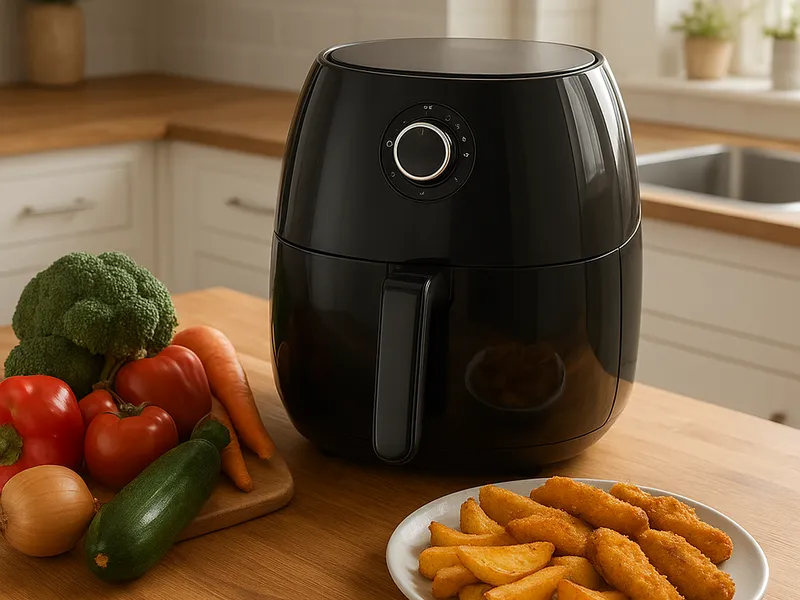
The short answer: air fryers do their best work on chicken wings, french fries, and roasted vegetables. These three benefit most from what the appliance actually is — a compact convection oven that blasts hot air across a small chamber — because they all depend on rapid surface drying and browning. Right behind them come chicken breasts, salmon, and crispy tofu, which cook faster and stay juicier than they typically do in a full-size oven.
Below you'll find the commonly recommended temperature and time ranges for each, drawn from widely published guidance rather than a single test kitchen's results. Every air fryer runs a little differently, so treat these as starting points and confirm doneness with a thermometer where it matters. If you're still choosing a machine, start with our best air fryers in 2026 or answer a few questions in the air fryer finder.
At a glance
- Chicken wings — 380–400°F, 18–26 minutes; the single best thing to air fry
- French fries (frozen) — 375–400°F, 10–15 minutes; no oil needed
- Roasted vegetables — 360–400°F, 10–20 minutes depending on the vegetable
- Chicken breast — around 375°F, 10–15 minutes for typical fillets
- Salmon — 400°F, 6–11 minutes depending on thickness
- Crispy tofu — 400°F, 10–15 minutes with a cornstarch coating
Chicken wings
If you only ever air fry one thing, make it wings. The circulating heat renders the fat under the skin while drying the surface, which is exactly the combination deep frying provides — minus the pot of oil.
Commonly recommended settings fall in two camps: 380°F for 22–26 minutes (gentler, good for larger wings) or 400°F for 18–22 minutes (crispier skin, faster). A popular two-stage approach starts around 380°F for most of the cook and finishes with about 5 minutes at 400°F to crackle the skin without drying the meat. Either way, flip the wings halfway through, leave space between pieces, and pull them when the internal temperature reaches 165°F.
Pat the wings dry before seasoning — surface moisture is the enemy of crisp skin — and skip wet batters, which slump and drip in an air fryer.
French fries and potatoes
Frozen fries are the air fryer's easiest win. Most published guidance clusters around 375–400°F for 10–15 minutes, shaking the basket every 5 minutes or so. Thin shoestring fries can be done in 10–13 minutes; thick steak fries may need closer to 20. Don't thaw them first, and don't add oil — most frozen fries are already par-fried with oil in the coating.
For homemade fries, cut the potatoes evenly, and either soak the cut fries to pull off surface starch or parboil them for 5–8 minutes until just tender. Dry them thoroughly, coat lightly with oil, and cook at the same 375–400°F range for roughly 10–15 minutes, adjusting for thickness. The two-step prep is what produces the fluffy-inside, crisp-outside contrast; skipping it usually yields leathery fries.
Roasted vegetables
Broccoli, Brussels sprouts, cauliflower, peppers, and zucchini all roast faster in an air fryer than in an oven, with more blistering and caramelization in less time. 400°F is the most commonly recommended temperature for hearty vegetables, though many recipes run broccoli a touch lower (around 360°F) and Brussels sprouts as high as 425°F.
Typical times: broccoli in about 10 minutes, halved Brussels sprouts in about 15 minutes at 400°F (or closer to 20 at 425°F), softer vegetables like zucchini and peppers in 8–12 minutes. Cut everything to a uniform size, toss with a small amount of oil and salt, keep the pieces in a single layer, and shake or stir halfway through. Overlapping pieces steam instead of roast — cook in two batches rather than one crowded one.
Chicken breast
Boneless chicken breast is where the air fryer beats the oven on juiciness, simply because the shorter cook time gives moisture less opportunity to escape. Most recipes recommend around 375°F (with a range of roughly 360–380°F), and time scales with size: about 10–12 minutes for small 4–5 oz breasts, 13–15 minutes for 6–8 oz, and up to 16–20 minutes for very large ones. Flip halfway, cook to an internal 165°F, and rest the meat for 5 minutes before slicing.
