
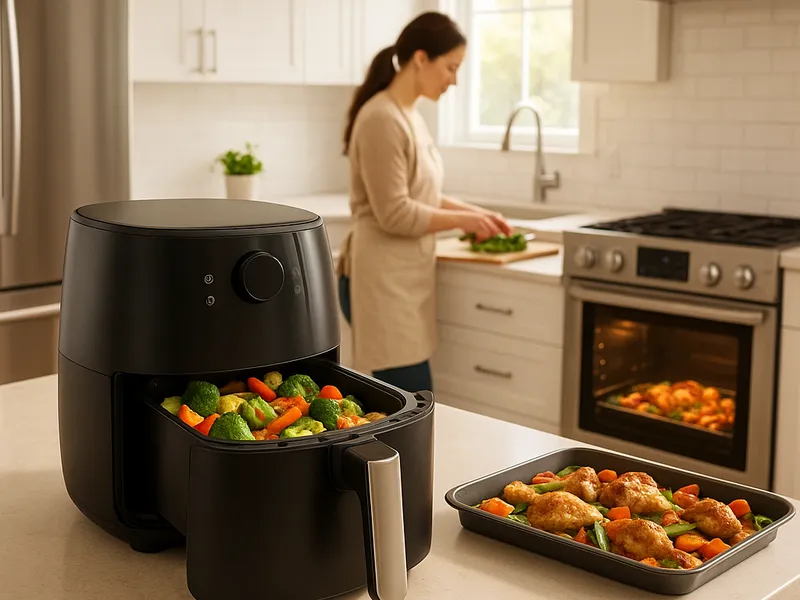
For most everyday cooking — weeknight sides, frozen foods, reheating, portions for one to three people — the air fryer is the better tool: it needs little to no preheating, cooks roughly 20–30% faster, and typically uses a quarter to half the electricity of a full-size electric oven. The conventional oven is better whenever quantity or precision matters: multiple trays, large roasts, casseroles, and baking that depends on steady, even heat. Lab testing by the UK consumer group Which? found an air fryer cooked a roast chicken for less than half the energy cost of an oven, but also noted that the savings erode once you have to cook in batches. In short: buy or use an air fryer for small, fast, crispy meals; keep the oven for volume and baking — most kitchens genuinely benefit from both.
Verdict at a glance
- Cooking for 1–3 people: Air fryer. Faster, cheaper to run, and less to clean.
- Cooking for 4+ or entertaining: Oven. One large chamber beats multiple air-fryer batches on both time and energy.
- Frozen foods and reheated leftovers: Air fryer. Circulating hot air restores crispness a microwave can't.
- Baking bread, cakes, and pastry: Oven. Better insulation, steadier temperatures, and room for proper pans.
- Large roasts and sheet-pan dinners: Oven. Most air fryer baskets can't fit a full sheet pan or a big joint.
- Cutting energy bills on small meals: Air fryer. Consumer testing consistently shows it uses a fraction of an oven's electricity for single dishes.
Head-to-head
| Dimension | Air fryer | Conventional oven | Winner |
|---|---|---|---|
| Speed | ~1–3 min preheat (often none); cooks ~20–30% faster | 10–15 min preheat; longer cook times | Air fryer |
| Energy | ~800–1,800W; roughly 0.3–0.6 kWh per typical session | ~2,000–5,000W; often 1.3–2.25 kWh per session | Air fryer |
| Capacity | 2–8 quarts; small batches only | 4–6+ cubic feet; multiple racks | Oven |
| Crispness | Excellent on fries, wings, veg; intense circulated heat | Good with convection; milder browning | Air fryer |
| Cleanup | One nonstick basket, often dishwasher-safe | Trays, racks, and periodic deep cleans | Air fryer |
| Cost | ~$50–$300 countertop unit | $600–$2,000+ installed range/wall oven | Depends on need |
Speed
The air fryer's biggest speed advantage is preheating. A conventional oven typically needs 10–15 minutes to reach temperature, while an air fryer needs one to three minutes — and many recipes skip preheating entirely. Once cooking starts, the small chamber and fast-moving air shave off roughly 20–30% more: chicken nuggets in about 15 minutes versus 20–25 in an oven, fries in 15–20 minutes versus 25–30. The oven only claws this back when volume forces the air fryer into multiple batches.
Energy use and running cost
The wattage gap tells most of the story. Air fryers draw roughly 800–1,800 watts; electric ovens draw about 2,000–5,000 watts and heat a far larger cavity for longer. Typical real-world figures put an air fryer session around 0.3–0.6 kWh versus 1.3–2.25 kWh for an equivalent oven session — a quarter to half the energy. In Which? lab tests, an air fryer roasted a chicken for 14p of electricity versus 30p in the oven, and cooked chips using about a third of the oven's energy. The UK's Energy Saving Trust and Australia's CHOICE reach the same conclusion: air fryers are cheaper to run for small quantities. The important caveat, flagged in the same testing, is batching — if you need three basket-loads to feed the family, the oven's single large bake becomes the more economical option.
Capacity
This is the oven's category, and it isn't close. A standard oven offers multiple racks and room for a full sheet pan, a whole turkey, or a lasagna alongside roasting vegetables. Most countertop air fryers run 2–8 quarts; even large dual-basket models comfortably feed three to four people per cycle, and overcrowding the basket is the classic cause of soggy results. If daily cooking means dinner for five, capacity alone decides this.
Crispness and cooking quality
Air fryers are essentially small, aggressive convection ovens, and the concentrated airflow close to the food is why they excel at browning: fries, chicken wings, roasted vegetables, and reheated fried foods come out crisper than most full-size ovens manage, with little or no added oil. Ovens win on evenness and control — better insulation and steadier temperatures matter for bread, cakes, custards, and anything delicate. A convection ("air fry") setting on a modern oven narrows the crispness gap, but consumer testing generally still gives compact air fryers the edge on texture for small portions.
Cleanup
An air fryer usually means washing one nonstick basket and tray, and many are dishwasher-safe. An oven session tends to generate sheet pans and racks, plus splatter inside a cavity that eventually demands a deep clean or a self-clean cycle (which itself uses significant energy). For daily use, the air fryer is simply less friction — one reason it becomes the default appliance in many small households.
