
# Bamboo Kitchen Tools: Which Ones Are Actually Worth Buying?
Bamboo is worth buying in three categories: cooking spoons and spatulas, steamer baskets, and cutting boards used for serving and light prep. These tools are lightweight, heat-tolerant, safe on nonstick coatings, and inexpensive — utensil sets typically run $15 to $30, and a two-tier steamer $25 to $45. Two things are not worth buying in bamboo: a primary chopping board (bamboo's natural silica content dulls knife edges noticeably faster than maple or walnut) and "bamboo-fiber" composite plates and cups, which are usually bamboo powder bound in melamine-formaldehyde resin and have been shown in retail surveys to leach both chemicals into hot food and drink.
Worth it vs skip at a glance
- Worth it: bamboo spoons and spatulas. Light, gentle on nonstick and cast iron, cheap to replace. The safest first bamboo purchase.
- Worth it: bamboo steamer baskets. The traditional tool for dumplings, bao, and vegetables; the lid absorbs condensation instead of dripping it onto food.
- Worth it (with a caveat): bamboo cutting boards for serving and light prep. Attractive, light, stain-resistant — not for daily knife work.
- Skip: bamboo as your primary chopping board. Harder than most hardwoods and rougher on edges; choose maple, walnut, or teak instead.
- Skip: bamboo-fiber composite tableware. Cups, bowls, and kids' plates molded from bamboo powder and melamine resin can release formaldehyde and melamine when hot.
- Skip: unbranded bargain sets with no materials information. Low-cost bamboo products sometimes use formaldehyde-based adhesives.
Comparison
| Tool | Bamboo advantage | Better alternative (if any) |
|---|---|---|
| Spoons and spatulas | Lightweight, heat-tolerant, safe on nonstick, resists odors and stains | Dense hardwood (beech, olive) if you want heirloom-weight tools |
| Steamer baskets | Lid absorbs steam so condensation doesn't drip on food; stackable tiers | Metal steamer insert if you want dishwasher convenience |
| Cutting boards (serving/light prep) | Light, hard, stain-resistant, inexpensive | — |
| Primary chopping board | None — silica dulls edges faster | End-grain maple, walnut, or teak |
| Composite plates and cups | None — melamine-formaldehyde leaching risk when hot | Solid bamboo, ceramic, or stainless steel |
Bamboo spoons and spatulas
This is the category where bamboo most clearly earns its place. Utensils made from solid Moso bamboo are stiff enough to scrape fond off a pan yet soft enough not to scratch nonstick coatings or cast-iron seasoning, and owners consistently report years of stovetop use without cracking or warping when hand washed. Widely available options include the Riveira Bamboo Cooking Spoons 6-Piece set (typically $20 to $30), covering solid and slotted spoons, spatulas, and a turner, and the Totally Bamboo / TB Home cooking utensil sets (roughly $15 to $30) with slightly tapered heads that reach pot corners.
Look for solid single-piece construction and a maker that confirms food-safe, formaldehyde-free adhesives and finishes.
Who should skip it: cooks who want thick, heavy hardwood spoons (bamboo handles feel thinner and lighter), and anyone unwilling to hand wash — repeated dishwasher cycles dry bamboo out and split it.
Bamboo steamer baskets
A stacked bamboo steamer is still the best low-cost way to cook dumplings, bao, fish, and vegetables, and it is one bamboo tool where no material upgrade is obviously better. The woven lid absorbs condensation rather than letting it drip back and sog your food, and tiers let you steam a main and a side at once. The Joyce Chen 2-Tier Bamboo Steamer (10-inch) is the long-running standard, typically $25 to $45, and Helen's Asian Kitchen steamers are a solid budget alternative; owners consistently report even cooking and tight, well-made slat weaves on both.
Who should skip it: occasional steamers who already own a metal insert, and anyone without a pot wide enough to seat the basket stably. Bamboo steamers must also air-dry completely between uses to prevent mold, so skip them if that upkeep won't happen.
Bamboo cutting boards
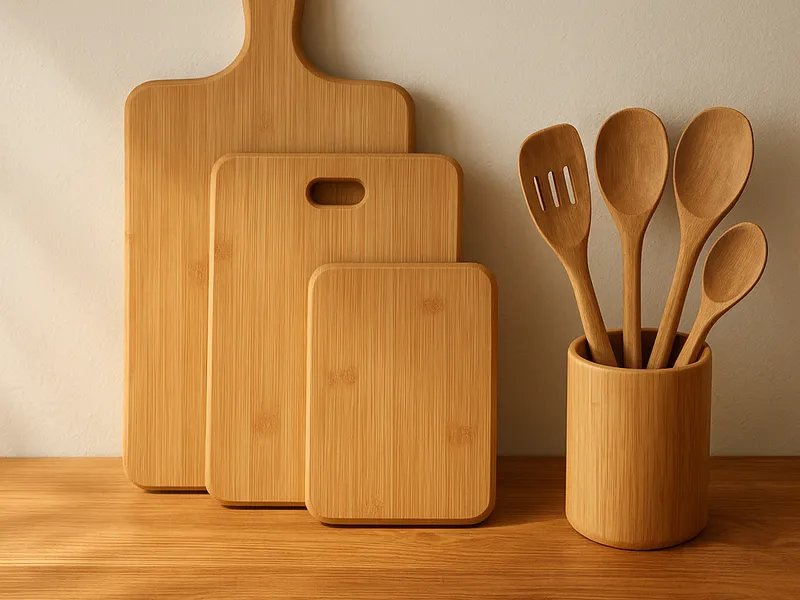
Here the answer is genuinely split. As a serving and light-prep surface — bread, cheese, charcuterie, quick fruit — a bamboo board is excellent: hard, light, inexpensive, and resistant to stains and odors. The Totally Bamboo 3-Piece Cutting Board Set (roughly $15 to $30) covers three sizes for exactly this kind of use.
As your primary chopping board, bamboo is a poor value. Bamboo contains natural silica and is harder than most cutting-board hardwoods, and comparisons consistently find knives dulling on the order of 20 to 30 percent faster on bamboo than on maple or walnut. Flat-grain bamboo also doesn't "self-heal" the way end-grain wood does, so deep knife scoring stays open and can trap food.
