
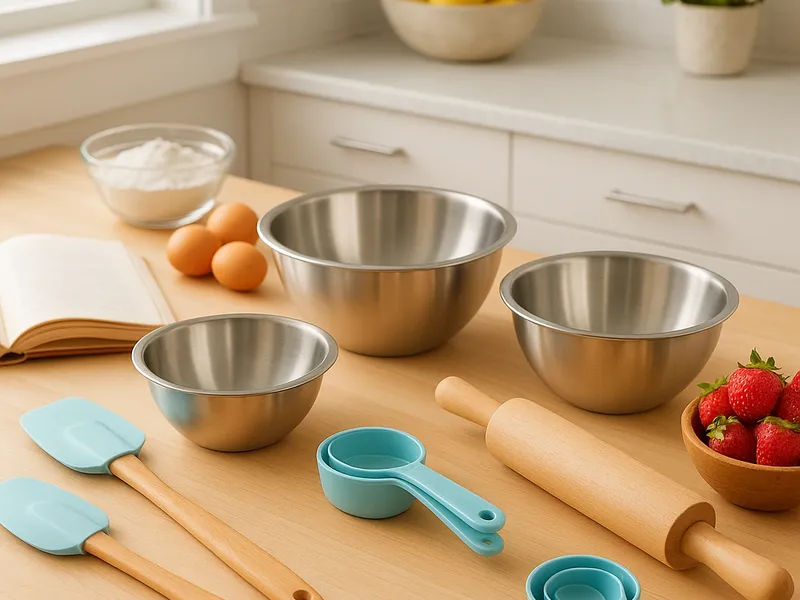
A beginner needs exactly five tools before anything else: a digital kitchen scale (Escali Primo, roughly $25–30), a rimmed half sheet pan (Nordic Ware Naturals, roughly $15–25), a silicone baking mat (Silpat, or Amazon Basics at under $10 for two), a metal loaf pan (USA Pan 1 lb, roughly $15–25), and a bench scraper (OXO Good Grips, roughly $10–15). Everything else — stand mixers, novelty cutters, specialty pans — can wait. For a total outlay around $75–110, this set covers cookies, quick breads, brownies, and most of the projects in our guide to what you can prepare with dough.
Our picks at a glance
- Best scale: Escali Primo — two buttons, 11 lb capacity, 1 g resolution
- Scale upgrade: OXO Good Grips 11 lb — pull-out display, roughly $50–60
- Best sheet pan: Nordic Ware Naturals Baker's Half Sheet — uncoated aluminum, made in the USA
- Best silicone mat: Silpat Premium (budget: Amazon Basics 2-pack)
- Best loaf pan: USA Pan 1 lb — aluminized steel, Americoat nonstick
- Best bench scraper: OXO Good Grips Multi-Purpose Scraper
Comparison
| Tool | Pick | Price range | Key spec | Best for |
|---|---|---|---|---|
| Digital scale | Escali Primo | $25–30 | 11 lb capacity, 1 g increments | Accurate flour and sugar measuring |
| Half sheet pan | Nordic Ware Naturals | $15–25 | Pure aluminum, reinforced steel rim | Cookies, roasting, sheet cakes |
| Silicone mat | Silpat Premium | $25–30 | Fiberglass-reinforced silicone, half-sheet size | Reusable nonstick surface |
| Loaf pan | USA Pan 1 lb | $15–25 | Aluminized steel, corrugated Americoat surface | Quick breads, sandwich loaves |
| Bench scraper | OXO Good Grips | $10–15 | Stainless blade with ¼-inch markings | Dividing dough, cleaning counters |
Escali Primo Digital Scale — the one tool that fixes most beginner bakes
Measuring flour by volume is the most common cause of dense beginner bakes, and a scale eliminates it. The Escali Primo weighs up to 11 pounds in 1-gram increments and runs on two buttons: power/tare and unit toggle. Owners consistently report readings stay steady even with a bowl off-center, and that the sealed face wipes clean easily. If you want a longer auto-shutoff and a pull-out display that stays visible under wide bowls, the OXO Good Grips 11 lb scale adds both at roughly $50–60.
Who should skip it: Nobody, honestly — but if you already own any scale that reads in grams, keep it; accuracy differences between decent scales don't matter for home baking.
Nordic Ware Naturals Baker's Half Sheet — the workhorse pan
This is the pan you will use more than everything else combined. The Naturals half sheet (13 x 18 inches) is uncoated pure aluminum, which conducts heat quickly and evenly, with a steel-reinforced rim designed to resist warping. It is made in the USA and typically sells for roughly $15–25. Owners consistently report even browning and pans that stay flat after years of use; the trade-off they mention — raw aluminum discolors and isn't dishwasher-friendly — is cosmetic. If you'd rather have nonstick built in, the USA Pan half sheet adds a corrugated Americoat coating that promotes airflow under cookies.
Who should skip it: Bakers with compact or countertop ovens a 13 x 18 pan won't fit — measure first; the quarter sheet (9 x 13) is the same pan scaled down.
Silpat Premium silicone mat — the reusable nonstick layer
Pair the sheet pan with a silicone mat and you rarely need to grease anything. Silpat's fiberglass-reinforced mat is sized for a half sheet, rated to around 480°F, and owners consistently report mats lasting a decade or more — the buy-once option. The Amazon Basics 2-pack costs under $10 total, and owners describe it as performing close to the Silpat, with thinner material, more staining, and some edge-curl at very high heat.
A mat isn't always the right liner — parchment still wins for lifting bars out of a pan or high-heat roasting. We break down when each makes sense in our comparison of silicone baking mats vs. parchment paper.
Who should skip it: Very occasional bakers — a few dollars of parchment does 90 percent of the same job with zero cleanup.
USA Pan 1 lb Loaf Pan — quick breads and first yeast loaves
USA Pan's loaf pans are aluminized steel — steel core for rigidity, aluminum coating for even heating — finished with Americoat, a PTFE- and PFOA-free silicone nonstick coating over a corrugated release surface. The standard 1 lb pan (about 8.5 x 4.5 inches) matches most banana bread and sandwich loaf recipes at roughly $15–25. Owners consistently report loaves releasing with little or no greasing, with the caveat that the coating rewards hand washing and non-metal utensils.
