
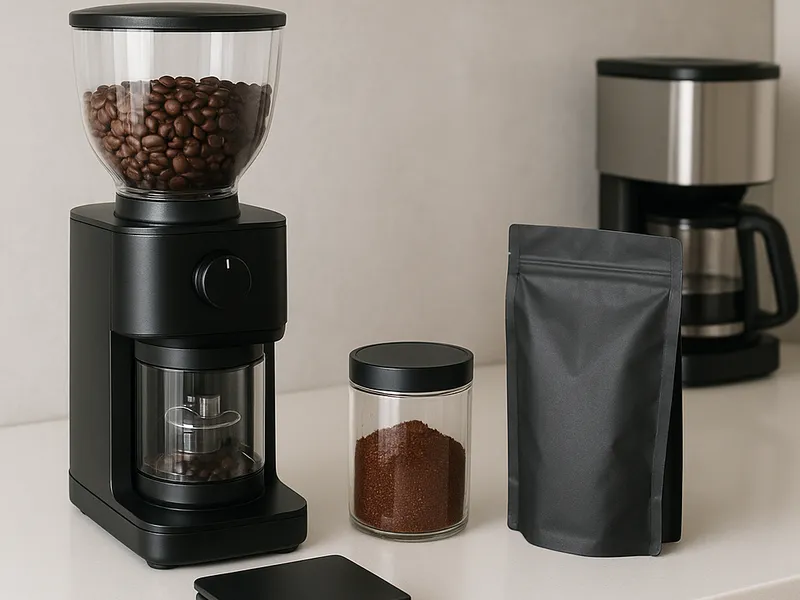
For most home brewers, the Baratza Encore is the grinder to get: 40mm conical steel burrs, 40 grind settings, and a repair-friendly design owners keep running for a decade or more. If you pull espresso, step up to the Baratza Encore ESP, which dedicates half its adjustment range to espresso-fine settings. Pour-over devotees chasing clarity should look at the Fellow Ode Gen 2 and its 64mm flat burrs; hand-grinder fans, at the 1Zpresso J-Ultra with its 8-micron adjustment clicks. On a tight budget, the OXO Brew Conical Burr Grinder delivers real burr consistency for around a hundred dollars, and the Timemore Chestnut C3 does the same in manual form for less.
Our picks at a glance
- Best for most people (drip and pour-over): Baratza Encore
- Best for espresso: Baratza Encore ESP
- Best upgrade for filter coffee: Fellow Ode Gen 2
- Best manual grinder: 1Zpresso J-Ultra
- Best budget electric: OXO Brew Conical Burr Grinder
- Best budget manual: Timemore Chestnut C3
Comparison
| Grinder | Burr type | Best for | Typical price range |
|---|---|---|---|
| Baratza Encore | 40mm conical steel | Drip, pour-over, French press | $130–$150 |
| Baratza Encore ESP | 40mm conical steel | Espresso plus filter | $180–$200 |
| Fellow Ode Gen 2 | 64mm flat steel | Pour-over, drip, cold brew | $300–$350 |
| 1Zpresso J-Ultra | 48mm conical, titanium-coated | Manual grinding, espresso to drip | $160–$190 |
| OXO Brew Conical Burr | 40mm conical stainless | Everyday drip on a budget | $95–$110 |
| Timemore Chestnut C3 | 38mm conical stainless (S2C) | Budget manual, travel | $50–$80 |
Baratza Encore — best for most people
The Encore has been the default entry-level burr grinder recommendation for years, and the spec sheet explains why: 40mm conical steel burrs, 40 stepped settings across a roughly 250–1,200 micron range — fine drip grind to French-press coarse — and gear-and-electronic speed reduction that holds the burrs to about 450 RPM, keeping heat and static low. Owners consistently report grind consistency that is a dramatic step up from any blade grinder, and Baratza's parts support is unusual in this category — long-term owners frequently describe rebuilding an Encore rather than replacing it.
Who should skip it: anyone serious about espresso — the stepped adjustments are too coarse at the fine end to dial in a shot reliably, the gap the ESP version fills. Owners also note it is not quiet, so early risers in small homes may prefer a manual grinder.
Baratza Encore ESP — best for espresso
The Encore ESP re-tunes the same reliable platform for espresso: 40mm conical stainless burrs, a 550 RPM high-torque motor, and 40 stepped settings split into 20 micro-stepped espresso settings and 20 for filter brewing. At just under $200 it is one of the cheapest electric grinders owners consistently report can keep up with a real espresso machine; the ESP Pro (around $300) adds stepless adjustment, single-dosing, and a digital interface.
Still choosing the machine that goes next to it? Our guide to the best coffee makers from espresso to cold brew covers the brewing side of the counter.
Who should skip it: filter-only brewers. If you never pull shots, the standard Encore does the same job for roughly $50 less.
Fellow Ode Gen 2 — best upgrade for filter coffee
The Ode Gen 2 is a specialist. Its 64mm flat steel burrs — a size normally seen in commercial equipment — spin at a PID-controlled 1,400 RPM with a two-stage cutting geometry aimed at particle uniformity. The 31 settings span pour-over through cold brew, and owners consistently report cleaner, brighter cups than entry conical grinders deliver, plus low grounds retention in the single-dose format.
Who should skip it: espresso drinkers, full stop — Fellow states plainly the Ode is not suitable for espresso, with a grind range bottoming out around 250–300 microns. Casual drip brewers will find the Encore covers most of the benefit at half the price.
1Zpresso J-Ultra — best manual grinder
Manual grinders have quietly become the best value in coffee, and the J-Ultra sits near the top of the category. Its 48mm titanium-coated conical burrs are larger than those in most sub-$300 electric grinders, and the external dial adjusts 8 microns per click — espresso-level precision. The magnetic catch cup holds 35–40g, the handle folds for travel, and owners consistently report grinding a double shot's worth of beans in well under a minute.
Who should skip it: anyone grinding for a crowd. Hand-grinding 20g is quick; 60g for a full carafe every day gets old, and owners who brew large batches routinely end up adding an electric grinder anyway.
