
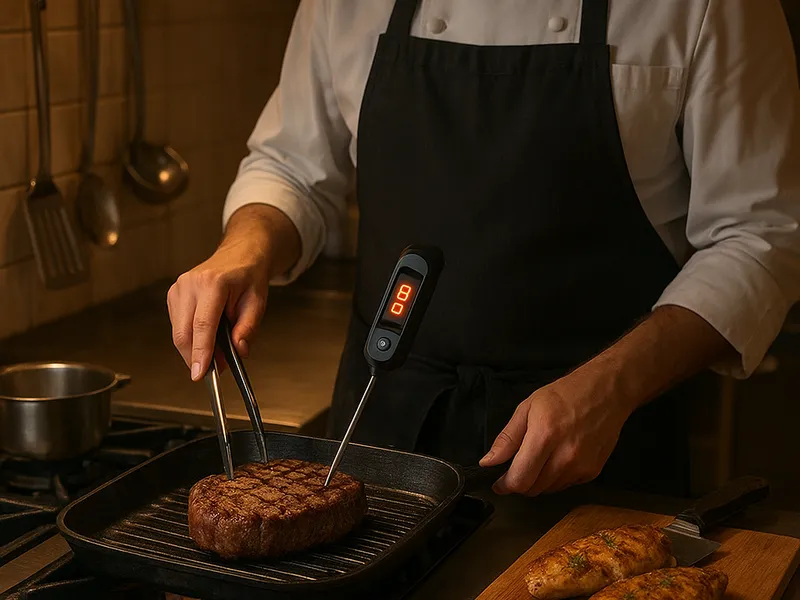
The best meat thermometer for most cooks is the ThermoWorks Thermapen ONE — a one-second instant-read with an IP67 waterproof body. At a third of the price, the ThermoWorks ThermoPop 2 delivers most of the same accuracy in a simpler package. And if you want to close the grill lid and walk away, the MEATER 2 Plus wireless probe lets you monitor a cook from your phone with no cables at all.
The right choice depends on how you cook: quick weeknight checks call for a different tool than a six-hour brisket. Below, the leading models compared on read speed, range, and waterproofing — plus the USDA targets you're aiming for.
Our picks at a glance
- Best instant-read: ThermoWorks Thermapen ONE — one-second readings, ±0.5°F accuracy, IP67 waterproof, roughly $100–$115.
- Best budget: ThermoWorks ThermoPop 2 — 2–3 second reads, IP67 waterproof, around $35.
- Best wireless probe: MEATER 2 Plus — fully wireless, five internal sensors, app monitoring, roughly $100–$130.
- Best midrange instant-read: Lavatools Javelin PRO Duo — 1–3 second reads, large backlit display, usually $50–$60.
- Best budget dual-probe: ThermoPro TP20B — two wired probes plus a remote receiver for long smokes, typically $50–$60.
Comparison
| Model | Type | Stated read speed | Temperature range | Water resistance | Typical price |
|---|---|---|---|---|---|
| ThermoWorks Thermapen ONE | Instant-read | 1 second | -58 to 572°F | IP67 (waterproof) | $100–$115 |
| ThermoWorks ThermoPop 2 | Instant-read | 2–3 seconds | -58 to 572°F | IP67 (waterproof) | ~$35 |
| MEATER 2 Plus | Wireless probe | Continuous monitoring | Internal to 221°F; ambient to 1,000°F | Fully waterproof | $100–$130 |
| Lavatools Javelin PRO Duo | Instant-read | 1–3 seconds | -40 to 482°F | IP65 (splash-resistant) | $50–$60 |
| ThermoPro TP20B | Wired dual-probe + remote | Continuous monitoring | Probes rated to 572°F | Not waterproof (receiver) | $50–$60 |
Prices shift with sales; treat these as ballpark ranges.
ThermoWorks Thermapen ONE — best instant-read
The Thermapen ONE's headline spec is a full-accuracy reading in one second, with manufacturer-stated accuracy of ±0.5°F and NIST-traceable calibration. The folding probe rotates 180 degrees, the display auto-rotates for either hand, and the IP67 housing shrugs off a rinse under the tap.
Owners consistently report that the speed is the feature they can't give up: checking a steak in three spots takes as long as one spot with a slower unit, which matters while the grill lid is open and losing heat.
Who should skip it: occasional cooks. At roughly three times the price of the ThermoPop 2, you're paying for a couple of seconds of speed and tighter accuracy that casual use will rarely notice.
ThermoWorks ThermoPop 2 — best budget pick
The ThermoPop 2 reads in a stated 2–3 seconds with ±1°F accuracy in common cooking ranges, and it shares the Thermapen's IP67 waterproof rating — unusual at this price. The auto-rotating backlit display is easy to read at arm's length.
Owners consistently report that it covers everything a home cook needs and is easy to fish out of a drawer. For most people cooking chicken and steak a few nights a week, this is the sensible default.
Who should skip it: high-heat grillers, for whom the extra second or two of read time keeps knuckles over the flames longer than they'd like. The 4.5-inch probe is also short for large roasts (an 8-inch version exists).
MEATER 2 Plus — best wireless probe
The MEATER 2 Plus is a single fully wireless probe: no cables through the oven door, no base station clipped to the grill. It packs five internal sensors plus an ambient sensor, tolerates internal temperatures to 221°F and ambient heat to 1,000°F, and is waterproof enough for sous vide and deep-frying. Bluetooth 5.2 long-range gives a typical stated range of 250 feet, and Wi-Fi bridging through the app extends monitoring anywhere.
Owners consistently report that the app's alerts and cook-time estimates are the killer feature for long roasts and smokes: set a target, get a notification, and stop hovering.
Who should skip it: cooks who mostly do quick-check work. A wireless probe monitors a cook in progress rather than spot-checking six burgers, and the app dependency is friction if you just want a number now. Thin cuts can also be too shallow for the probe's minimum insertion depth.
