
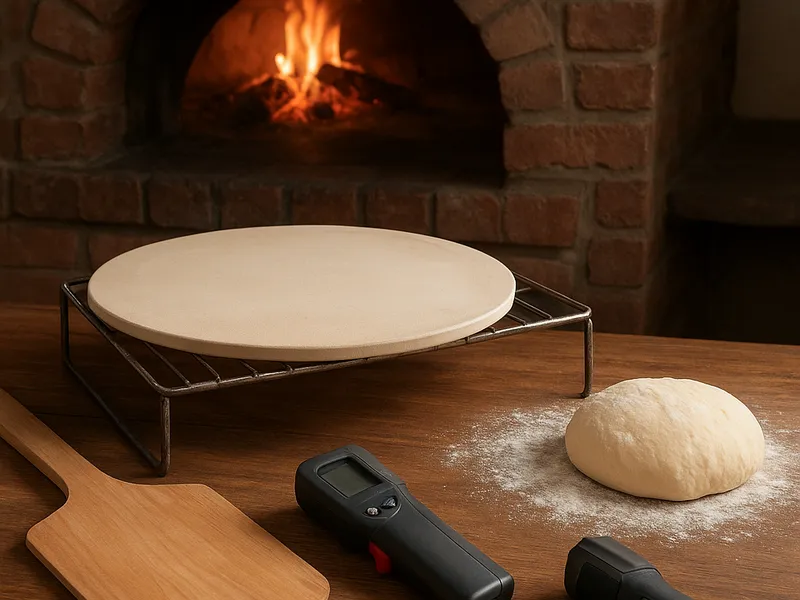
For most home ovens, a baking steel beats a baking stone — steel conducts heat far faster, so you get a browned, blistered bottom crust at 500°F instead of a pale one. The Original Baking Steel is the pick for most people, the NerdChef Steel Stone the thicker alternative, and a cordierite stone like the Unicook 15 x 12 inch the budget or outdoor-oven choice. For peels, use two: a wood peel to launch (raw dough sticks less to it) and a thin aluminum peel such as the Chef Pomodoro to turn and retrieve. Finish the kit with an infrared thermometer — the ThermoWorks Industrial IR Gun or the sub-$30 ThermoPro TP30 — so you launch only when the surface is actually hot enough.
Our picks at a glance
- Best baking surface for home ovens: Original Baking Steel
- Heavier-duty steel alternative: NerdChef Steel Stone
- Best budget surface: Unicook cordierite pizza stone
- Best metal peel: Chef Pomodoro aluminum peel
- Best peel for outdoor ovens: Ooni 12" perforated peel
- Best IR thermometer: ThermoWorks Industrial IR Gun
- Best budget IR thermometer: ThermoPro TP30
Comparison
| Product | Type | Key spec | Price range |
|---|---|---|---|
| Original Baking Steel | Baking steel | 14 x 16 x 1/4 in, pre-seasoned | $100–$140 |
| NerdChef Steel Stone | Baking steel | 14.5 x 16 in; three thicknesses | $90–$180 |
| Unicook cordierite stone | Pizza stone | 15 x 12 in, rated to 1,450°F | $30–$50 |
| Chef Pomodoro aluminum peel | Metal peel | Thin blade, folding handle | $30–$60 |
| Ooni 12" perforated peel | Metal peel | Perforated aluminum | $50–$70 |
| ThermoWorks Industrial IR Gun | IR thermometer | –76 to 1022°F, 12:1 ratio | $40–$60 |
| ThermoPro TP30 | IR thermometer | –58 to 1022°F, 12:1 ratio | $20–$30 |
Original Baking Steel — best surface for home ovens
The company that popularized the pizza steel still makes the benchmark: a 14 x 16 inch, quarter-inch, pre-seasoned slab made in the USA. Steel transfers stored heat into dough much faster than stone, and owners consistently report dramatically better browning and shorter bakes in 500–550°F home ovens. It can't crack, and rust sands off and re-seasons.
Who should skip it: anyone with an outdoor oven that hits 800°F+ — steel scorches the bottom there before the top finishes — and anyone unwilling to wrangle a 16-pound slab.
NerdChef Steel Stone — heavier-duty steel alternative
NerdChef sells the same core idea in three thicknesses (1/4, 3/8, and 1/2 inch) with a low-friction ground finish. Thicker steel stores more heat, and owners consistently report faster surface recovery between back-to-back bakes. The trade-off is weight and preheat time — the 1/2-inch "Ultimate" is a two-hand lift costing well over $150.
Who should skip it: occasional bakers; the standard Original Baking Steel preheats faster, weighs less, and usually costs less than the thicker NerdChef models.
Unicook cordierite stone — best budget surface
If $100+ for a steel isn't in the budget, a cordierite stone still beats a sheet pan. Unicook's 15 x 12 inch stone is rated heat-safe to 1,450°F and typically sells for $30–$50. Cordierite handles thermal stress better than plain ceramic, though owners consistently report any stone can eventually crack — avoid sudden temperature swings.
Who should skip it: bakers chasing maximum browning in a home oven; at 500°F, steel simply outperforms stone.
Chef Pomodoro aluminum peel — best metal peel
A thin aluminum blade slides under a baked crust far more easily than wood, making metal the better material for turning and retrieving. The Chef Pomodoro's folding handle is the feature owners consistently praise — it stores in a drawer instead of leaning in a corner. Still, build and launch the raw pizza from a floured wood peel (any flat hardwood peel in the $20–$40 range works), because raw dough grips slick metal.
Who should skip it: if you make one pizza at a time in a home oven, a single wood peel and tongs will get you by.
Ooni 12" perforated peel — best for outdoor ovens
For compact outdoor ovens (see our guide to the best pizza ovens), a perforated aluminum peel earns its premium: the holes shed excess flour so it doesn't burn on an 800°F stone, and owners consistently report it's lighter and easier to maneuver for the quarter-turns those ovens demand.
