
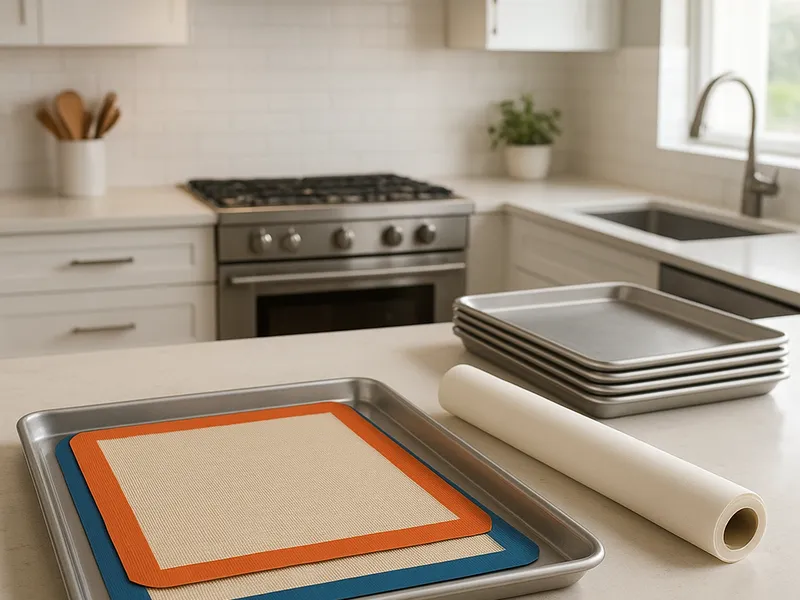
If you bake more than once a week, buy a silicone baking mat and keep parchment paper on hand for high-heat jobs — that's the short answer. Parchment is the better choice when browning matters (crisp-bottomed cookies, roasted vegetables, high-temperature bread) because bakers consistently report that silicone's insulating layer softens bottoms and slows color. Silicone mats are the better choice for repeat, moderate-heat work — cookie batches, macarons, candy and caramel — where their nonstick durability and reusability pay for themselves. Most kitchens benefit from owning both; together they cost less than a decent sheet pan.
Verdict at a glance
- Crisp, browned cookie bottoms: Parchment paper. Direct contact with the hot pan promotes browning; silicone insulates and yields paler, softer bottoms.
- Roasting vegetables at 425°F+: Parchment (watch the temperature rating) or bare pan. Silicone's insulation works against the caramelization you want.
- Macarons, meringues, tuiles, delicate pastry: Silicone mat. Owners consistently report the most reliable release and the most even, gentle bake for finicky items.
- Candy, caramel, brittle, chocolate work: Silicone mat. Nothing sticks, and the mat shrugs off sugar work that would glue itself to paper.
- Baking a few times a month: Parchment paper. Low upfront cost, zero cleanup, no storage fuss.
- Baking several times a week: Silicone mats. The math flips in silicone's favor fast — see the cost section below.
Head-to-head
| Dimension | Silicone baking mat | Parchment paper |
|---|---|---|
| Browning | Insulates; paler, softer bottoms | Better browning and crisp edges |
| Temp limit | ~428°F official (Silpat); retailers cite up to 480–500°F | Most brands rated to ~425°F; some to 450°F |
| Cost over time | ~$20–30 once; rated for 2,000–3,000 uses | ~$0.10–0.25 per sheet, forever |
| Cleanup | Wash and dry after every use | Toss it (or reuse a few times) |
| Reuse | Years of service with basic care | Single-use to a handful of uses |
Browning: parchment wins where color matters
This is the difference bakers notice first. A silicone mat is an insulating layer between dough and hot metal, and owners consistently report the same result: cookies baked on silicone come out with paler, softer bottoms and often need an extra minute in the oven, while the same dough on parchment develops crisper edges and deeper color. Parchment is thin enough that heat transfers almost as if the dough were on bare metal.
That insulation is not always a flaw. For meringues, macarons, and thin lace cookies, silicone's gentler bottom heat means fewer scorched edges and a more even bake. But for cookies with bakery-style crisp rims, caramelized roasted vegetables, or anything where browning is the point, reach for parchment.
Temperature limits: closer than the marketing suggests
Silpat, the original silicone mat brand, officially rates its mats from -40°F to 428°F, though many retailers list 480°F and some competing mats claim 500°F. Treat roughly 450°F as a practical ceiling for most silicone, and never use a mat under the broiler or in direct contact with a heating element.
Most parchment paper is labeled safe to about 425°F (Reynolds' rating), with some silicone-coated varieties rated to 450°F. In practice, America's Test Kitchen found that parchment used above its rating doesn't release harmful chemicals or catch fire in normal oven use — it darkens and turns brittle at the exposed edges. For very high-heat work like pizza or bread baked at 500°F+, exposed parchment edges will char, so trim the paper to the pan and expect to replace it after a bake or two. Neither product is a broiler liner.
Cost over time: silicone pays for itself if you bake weekly
The math is straightforward. A quality half-sheet silicone mat runs $20–30, and manufacturers rate mats like Silpat for 2,000–3,000 uses. Parchment typically works out to roughly $0.10–0.25 per sheet depending on whether you buy rolls or pre-cut sheets (bulk packs of 200 pre-cut sheets run about $17–20).
If you bake twice a week, a mat covers its cost against parchment within a year or two — faster if you were buying pre-cut sheets. Frugal bakers also note that parchment is somewhat reusable: a sheet used for cookies can go several rounds before it crumbles. If you bake only occasionally, a $6 roll of parchment will outlast your enthusiasm, and the mat never earns its keep.
There's a waste angle too: unbleached, compostable parchment (If You Care is the common pick) softens the disposability objection, while a mat generates essentially zero ongoing waste.
