
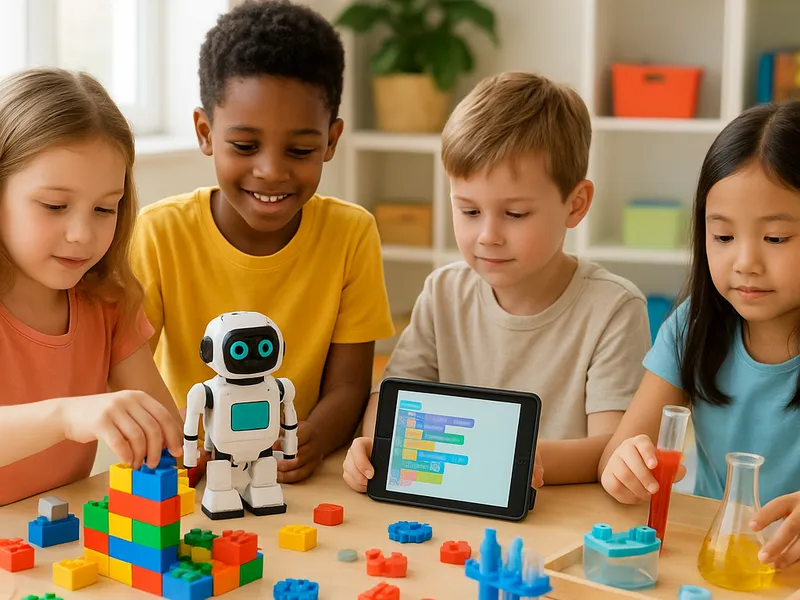
The single best STEM toy we recommend across the widest age range is a good set of magnetic building tiles like Magna-Tiles — they teach geometry, balance, and engineering through open-ended play and grow with a child from age 3 well into elementary school. For toddlers we would start with Fat Brain Toys Dimple Duo, and for elementary kids ready to code we would pick Botley 2.0 (screen-free, ages 5-7) or Snap Circuits Jr. (electronics, ages 8+). Match the toy to where your child is developmentally, not just their birthday, and you almost can't go wrong.
Our picks at a glance
- Fat Brain Toys Dimple Duo — tactile cause-and-effect play — best for babies and young toddlers (6 months-2 years).
- Magna-Tiles (or quality alternatives) — open-ended building that teaches geometry and physics — best for preschoolers and beyond (3-8 years).
- Botley 2.0 Coding Robot — screen-free first coding — best for early elementary (5-7 years).
- Snap Circuits Jr. SC-100 — hands-on electronics with no soldering — best for elementary builders (8+).
- Sphero BOLT / mBot Neo — app-based programmable robotics — best for tweens ready for real coding (8+).
How to choose
- Match developmental stage, not just age. A cautious 4-year-old may love a shape sorter while an advanced 7-year-old is ready for block coding. Age labels are a starting point, not a rule.
- Favor open-ended over single-function. Toys that can be used many ways (building tiles, circuits) deliver far more learning hours and replay value than a toy that does one thing.
- Decide screen vs. screen-free. Younger kids generally benefit from screen-free, tactile play. App-based robots add depth for older kids but require a compatible tablet or phone.
- Check safety and durability. For under-3s, avoid small parts and choke hazards. For any tile or circuit set, sturdier components survive years of rough handling.
- Think about runway. The best value comes from toys a child won't outgrow in a season. Magnetic tiles and modular kits keep delivering as skills advance.
Fat Brain Toys Dimple Duo
A colorful tactile board with raised silicone bubbles to poke and pop, plus shapes and multilingual labels. It is pure cause-and-effect learning for the youngest scientists. Price tier: budget ($).
- Pros: Safe and grippable for small hands, engages fine motor skills and sensory exploration, no screens or batteries.
- Cons: Limited play depth as a child grows; outgrown by around age 2-3.
- Best for: Babies and toddlers taking their first steps into figuring out how the world responds to them.
- Skip it if: Your child is already past simple sensory play and ready to build or sort.
Magna-Tiles
Translucent, solid plastic tiles with magnets along every edge that snap into 2D and 3D structures. Reviewers consistently call magnetic tiles the single best STEM investment for the preschool years because they quietly teach geometry, symmetry, balance, gravity, and structural planning. Price tier: premium ($$$), with capable alternatives like Picasso Tiles or Connetix at lower tiers.
- Pros: Endlessly open-ended, grows with the child from age 3 to 8+, durable, encourages experimentation and trial-and-error.
- Cons: Genuine Magna-Tiles are pricey; magnets are weaker than Magformers, so tall builds can topple.
- Best for: Preschoolers and early elementary kids; the most universally recommended STEM pick.
- Skip it if: Your child specifically wants intricate 3D geometric frames — Magformers' open-frame tiles and stronger single magnet suit ages 5+ better there.
Botley 2.0 Coding Robot
A small robot you program with a remote — no tablet or app required. Kids enter sequences of commands to make it navigate paths, avoid obstacles, and follow loops, building sequential and logical thinking. Price tier: mid ($$).
