
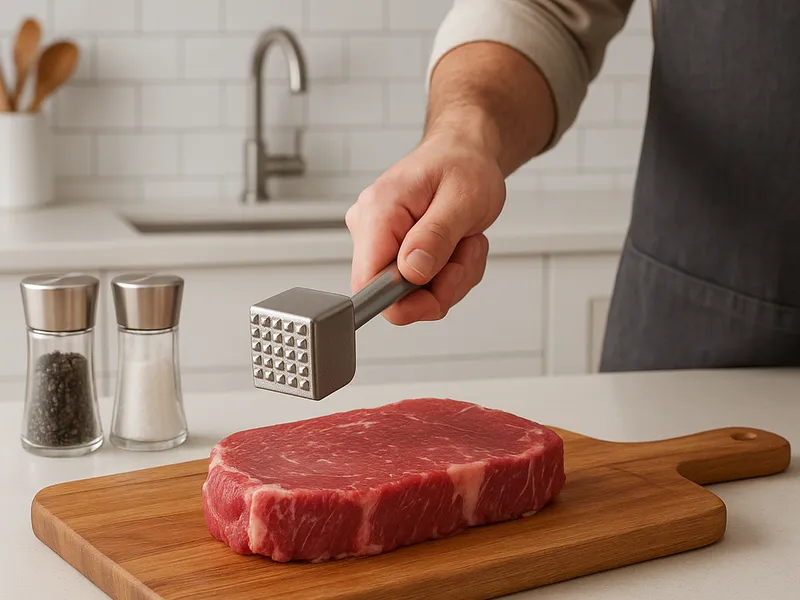
For most home cooks, the best meat tenderizing tool is the OXO Good Grips Die Cast Meat Tenderizer, a weighted dual-sided mallet that flattens cutlets and breaks down tough fibers without shredding them. If your goal is getting marinade deep into thick or lean cuts, the Jaccard Supertendermatic 48-Blade Tenderizer is the long-standing category benchmark, and the Ofargo Stainless Steel Meat Injector is the pick for pushing brines and marinades directly into large roasts and BBQ cuts. A tidy middle option — the OXO Good Grips Easy-Clean Bladed Meat Tenderizer — suits cooks who want blade-style results with less cleanup fuss.
Our picks at a glance
- OXO Good Grips Die Cast Meat Tenderizer — a comfortable, well-balanced mallet with a flat side and textured side; the first tool most kitchens should own.
- Jaccard Supertendermatic 48-Blade Tenderizer — 48 stainless blades that cut micro-channels for faster marinating and more even cooking; for cooks who regularly tackle tough or game cuts.
- OXO Good Grips Easy-Clean Bladed Meat Tenderizer — a compact 50-blade tool with a removable cartridge that simplifies washing; for blade-tenderizer results with minimal maintenance.
- Ofargo Stainless Steel Meat Injector — a 304 stainless barrel with interchangeable needles for injecting marinades into roasts, briskets, and whole birds; for grillers and smokers.
- Norpro Grip-EZ Meat Pounder — a simple, affordable flat pounder; for occasional cutlet-flattening on a budget.
Comparison
| Tool | Type | Best for | Cleanup | Typical price range |
|---|---|---|---|---|
| OXO Die Cast Tenderizer | Dual-sided mallet | Cutlets, chops, general use | Easy (hand wash) | Under $30 |
| Jaccard 48-Blade | Blade (needle) tenderizer | Tough cuts, fast marinating | Moderate (blades need care) | Under $30 |
| OXO Easy-Clean Bladed | Blade tenderizer | Blade results, easy washing | Easy (removable cartridge) | Under $30 |
| Ofargo Injector | Marinade injector | Roasts, brisket, poultry | Moderate (needles, barrel) | Under $30 |
| Norpro Grip-EZ Pounder | Flat pounder | Occasional flattening | Easy | Under $20 |
The mallet most kitchens should start with
The OXO Good Grips Die Cast Meat Tenderizer pairs a smooth flat face for pounding cutlets to even thickness with a textured face for breaking down denser fibers. Per OXO's specifications, the die-cast aluminum head is weighted so the tool does much of the work, and the non-slip Good Grips handle keeps strikes controlled. Owners consistently report that the rounded edges of the flat face flatten chicken breasts and pork evenly without tearing or leaving divots — a common complaint with cheaper stamped-metal mallets. It carries a roughly 4.8-star average across thousands of retail reviews.
Who should skip it: if your main goal is deep marinade penetration into thick steaks or roasts rather than evening out thickness, a blade tenderizer or injector will serve you better; a mallet mostly works the surface.
The blade tenderizer benchmark
The Jaccard Supertendermatic 48-Blade Tenderizer has been the reference point in this category for decades and is common in restaurant kitchens. Its 48 double-edged stainless blades pierce the meat in a grid, severing connective fibers and opening micro-channels that let marinades reach the interior. Jaccard's own guidance says this can meaningfully shorten marinating time and reduce cooking time slightly by letting heat penetrate more evenly. Owner reviews consistently praise how little pressure it takes to work through tough cuts — flank, chuck, venison — and how it preserves the shape of the meat rather than flattening it.
Who should skip it: cooks who mostly make thin cutlets (a mallet is the right tool for flattening), and anyone unwilling to clean carefully around blades. Note that any blade tenderizer pushes surface bacteria into the interior, so blade-tenderized meat should be cooked to a verified safe internal temperature.
The easier-cleaning blade option
The OXO Good Grips Easy-Clean Bladed Meat Tenderizer packs 50 stainless blades into a compact body, and its defining feature — per OXO's specs — is a removable blade cartridge that lifts out for rinsing, addressing the biggest owner complaint about blade tenderizers generally: trapped meat particles. Reviewers frequently cite the smaller footprint and simpler washing as reasons they actually use it regularly instead of leaving it in a drawer. It averages around 4.6 stars across owner reviews.
Who should skip it: high-volume cooks processing large or very tough cuts may prefer the Jaccard's longer track record and wider blade coverage per press.
