
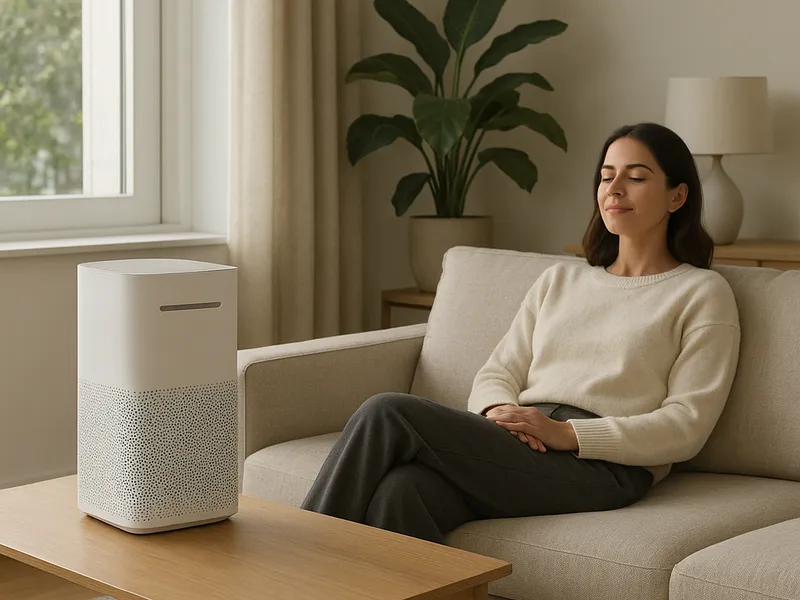
HEPA Air Purifiers: What Size You Need for Your Room
Article
2026-01-22 • 5 min read

HEPA Air Purifiers: What Size You Need for Your Room

HEPA Air Purifiers: What Size You Need for Your Room. Choosing the right size for a HEPA air purifier begins with understanding two core ideas: how fast you want the air refreshed and how big the space is. A purifier that is too small for a room will struggle to clean the air effectively, while an oversized unit can waste energy and produce more noise than you need.

Choosing the right size for a HEPA air purifier begins with understanding two core ideas: how fast you want the air refreshed and how big the space is. A purifier that is too small for a room will struggle to clean the air effectively, while an oversized unit can waste energy and produce more noise than you need. The sweet spot lies in matching the purifier’s performance ratings to the room you want to treat, taking into account both the size of the room and your specific air quality goals.

One of the most useful performance metrics for shoppers is the CADR, or Clean Air Delivery Rate. CADR is expressed in cubic feet per minute and tells you how much clean air a purifier can deliver for smoke, dust, and pollen. A related concept is ACH, or air changes per hour. Most homes benefit from about four to six air changes per hour in living spaces, with higher targets for bedrooms or environments where smoke or strong odors are present. To translate room size into a CADR target, you can use a simple equation: CADR target equals the room’s volume in cubic feet multiplied by the desired ACH, divided by sixty. If you don’t want to do the math, many manufacturers and retailers present room size guidelines and CADR ranges that align with common room shapes.

Start by measuring your room: length, width, and height. Multiply length by width to get the floor area in square feet, then multiply by height to obtain volume in cubic feet. For a bedroom that is twelve feet by twelve feet with eight foot ceilings, the volume is about one thousand four hundred eighty cubic feet. If you aim for five air changes per hour, the CADR target would be roughly one thousand four hundred eighty times five divided by sixty, or around one hundred twenty-five cubic feet per minute for each air stream (smoke, dust, pollen combined). In practice you won’t find a purifier that delivers exactly that number for all streams, but you can use it as a guide to compare products that claim similar CACDR values for different pollutants.

With the math in hand, you’ll want to consider real world performance. CADR is measured in controlled tests and can differ in a real home due to layout, doorways, and other airflow barriers. Look for units that publish CADR numbers for at least two pollutant categories (smoke and dust, for example) and check whether the product has been AHAM-tested. If you have specific sensitivity, such as severe allergies or a smoker in the household, plan for a higher ACH or choose a purifier with a higher CADR than your calculated target. It is also helpful to consider the unit’s noise level and energy use, because a purifier running continuously at high speed can become a source of annoyance or a steeper electricity bill.

HEPA Air Purifiers: What Size You Need for Your Room

When it comes to size categories, most rooms fall into three practical ranges. Small rooms or bedrooms often require CADR values in the range of one hundred to two hundred; medium living spaces are typically best served by around two hundred to four hundred CADR; large open-plan areas may need four hundred CADR or more. Some purifiers are designed for multi-room homes or dedicated zones, but for most apartments and houses a single well-chosen unit can achieve meaningful improvement in air quality, especially when used in conjunction with good filtration practices and regular maintenance.

To make the choice concrete, it helps to compare some of the top brands and where you can buy them. Levoit offers affordable, compact options with straightforward filter changes and a wide retail presence on Amazon, Walmart, and major home goods stores. Coway is known for robust performance and simple controls, with popular models often available through Amazon, Best Buy, and Costco. Honeywell remains a staple in hardware stores and home improvement retailers such as Home Depot and Lowe’s, offering reliable units with broad availability and replacement filters. For premium performance and design, Blueair and Dyson provide high-end options, with distribution through their own sites as well as major retailers like Amazon and Best Buy. Philips and IQAir serve the market with feature rich or high efficiency options, available through electronics and home goods channels. Depending on your needs, you may find the best deal on these brands through Amazon, Home Depot, Best Buy, Lowe’s, Costco, Wayfair, or direct from manufacturer stores.

If you’re new to the category, here are practical steps to get started without feeling overwhelmed. First, determine the room you want to treat and carry out the simple volume calculation. Second, decide your target ACH and convert that into a CADR target. Third, compare models by CADR, filter replacement costs, and noise levels. Fourth, consider where you will place the purifier. For optimal performance, keep the unit away from walls, position it where air can circulate freely, and avoid blocking intake and exhaust vents. Fifth, check filter availability and cost so ongoing maintenance remains affordable. And lastly, remember that a purifier is most effective when used as part of a broader air quality strategy, which can include reducing emissions, avoiding unnecessary burning, and improving ventilation where safe and practical.

For many households, the right purifier size is a balance between performance, price, and tolerance for noise. Start with a realistic room size, pencil in your target air changes per hour, and pick a model with a CADR comfortably above your calculated need. If you’re unsure between two models, lean toward the one with the higher CADR and lower noise at typical speeds, plus better filter replacement economics. In practice, even a well-chosen midrange purifier can make a noticeable difference in bedroom sleep quality, living room comfort, and overall indoor air freshness.

← Back to all articles