
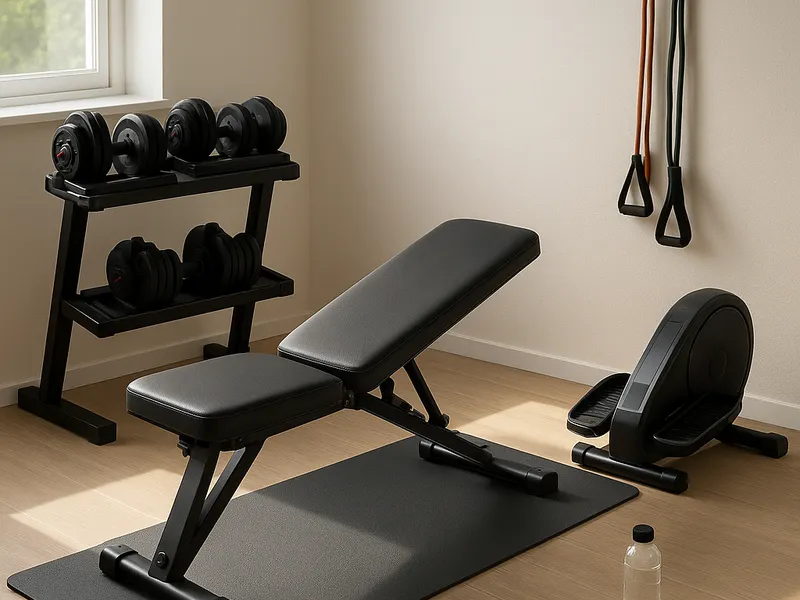
For most consistent exercisers, a home gym wins the money fight: a basic strength setup costs about as much as one year at a mid-tier commercial gym and pays for itself within roughly one to three years, after which it is essentially free. Our pick for the best value is a simple adjustable bench plus a quality set of adjustable dumbbells — it covers the most exercises per dollar and breaks even fastest. But if you only train a few times a month, value variety and classes, or can't dedicate floor space, a budget gym membership is the smarter money call.
The honest answer is that "cheaper" depends entirely on how often you'll actually show up and what you want to do. Below we break down the equipment worth buying, the membership tiers worth paying for, and how to run the math for your own situation.
Our picks at a glance
- Adjustable dumbbells (e.g. NordicTrack Select-A-Weight, Bowflex Results Series) — most exercises per dollar and per square foot — best for the fastest home-gym break-even.
- Adjustable weight bench — turns dumbbells into a full upper- and lower-body system — best for pairing with the pick above.
- Power/squat rack with barbell (REP PR-4000, Titan X-3, Rogue R-3) — serious progressive strength training at home — best for committed lifters with space.
- All-in-one functional trainer (Force USA G20, Major Fitness B17, Tonal 2) — replaces a whole gym floor in one footprint — best for replacing a premium membership entirely.
- Budget gym membership (Planet Fitness, Crunch) — low monthly cost, no upkeep, full equipment variety — best for occasional or social exercisers.
How to choose
- Your real attendance. A membership only "saves money" if you use it; the average lapsed membership is pure waste. A home gym removes the commute excuse but needs self-motivation. Be honest about which failure mode is yours.
- Break-even timeline. A roughly $500–$700 bench-and-dumbbell setup recoups its cost against a $50–$100/month gym in about 6–10 months; a $1,500 setup typically breaks even in two to three years. After that, home equipment costs nothing per month.
- Space and noise. Dumbbells and a bench fit in a closet corner. A power rack needs a garage or basement with ceiling height. Apartments push you toward compact gear or a membership.
- Training goals. Classes, pool, sauna, and a huge machine selection favor a gym. Strength training, convenience, and 24/7 access favor home.
- Resale value. Unlike membership fees, quality racks, plates, and dumbbells hold value and can be sold later — a real factor in the lifetime cost.
Adjustable dumbbells
A single pair of adjustable dumbbells replaces an entire rack of fixed weights, which is why it's the highest-value first purchase for a home gym. The NordicTrack Select-A-Weight runs to roughly 55 lb per hand and is widely praised as a value pick; Bowflex's Results Series 552/1090 are the current, redesigned dumbbells offered as replacements after the older SelectTech 552 and 1090 models were recalled in mid-2025 over plates that could dislodge.
- Pros: Massive exercise range, tiny footprint, fast break-even, strong resale.
- Cons: Limited for heavy lower-body work; dial mechanisms can be bulkier than fixed weights.
- Best for: Anyone wanting the cheapest, fastest path to a useful home gym ($–$$).
- Skip it if: You're chasing heavy barbell squats and deadlifts — you'll need a rack and plates.
If you buy Bowflex, confirm you're getting the current Results Series and not old recalled stock; check the manufacturer's recall page before purchasing secondhand.
Adjustable weight bench
A flat-incline-decline bench is the cheap multiplier that turns dumbbells into a near-complete strength tool, unlocking presses, rows, step-ups, and core work. It's the natural partner to the dumbbell pick and keeps your total under the cost of a single year at most commercial gyms.
- Pros: Inexpensive, durable, enables dozens of additional movements.
- Cons: Cheapest models can wobble; you still need weights to use it.
- Best for: Pairing with adjustable dumbbells for a complete budget setup ($).
- Skip it if: You only do bodyweight or cardio training.
Power/squat rack with barbell
For real progressive overload, a power rack with a barbell and plates is the gold standard. Reviewers consistently rate the REP Fitness PR-4000/PR-5000 and Titan X-3 as matching or beating comparable Rogue racks at a lower price, while Rogue's R-3/RML series remains the premium benchmark with the cleanest welds and finish.
- Pros: Train heavy and safely solo (spotter arms), highly expandable, excellent longevity and resale.
- Cons: Highest upfront cost of the strength picks; needs dedicated space and ceiling height.
- Best for: Committed lifters who want a lifetime setup ($$–$$$).
- Skip it if: You rent a small apartment or aren't sure you'll stick with lifting.
