
Lung Test
Article
2025-12-12 • 6 min read

Lung Test

Lung tests sit at the intersection of clinical assessment and personal health monitoring. They are not just about confirming a disease label; they are about understanding how well the lungs move air, how efficiently oxygen passes into the blood, and how con...

Lung tests sit at the intersection of clinical assessment and personal health monitoring. They are not just about confirming a disease label; they are about understanding how well the lungs move air, how efficiently oxygen passes into the blood, and how conditions like asthma, COPD, or restrictive disorders shape everyday breathing. In recent years the landscape has widened from traditional clinic visits to home friendly devices and digital platforms that connect patients with clinicians in real time. This evolution is changing how individuals track their lung health, how clinicians detect changes early, and how researchers gather data for better treatments.

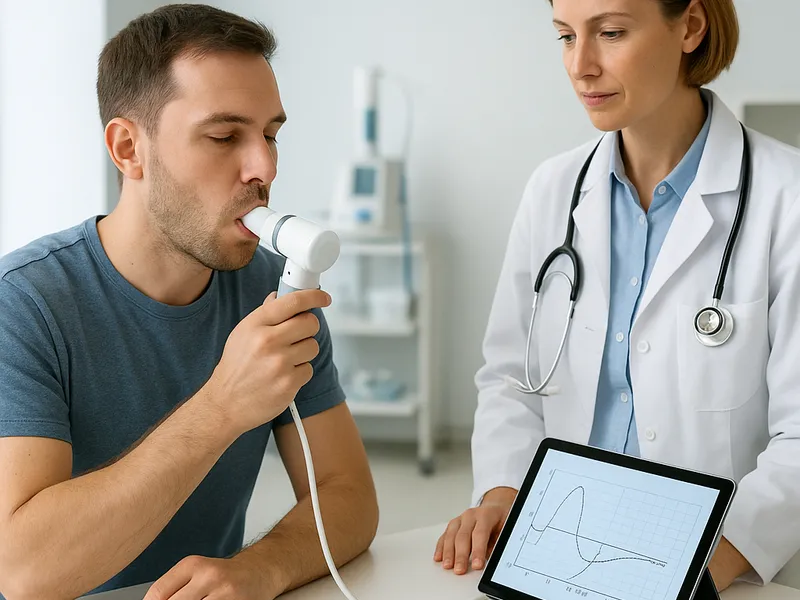
The most common lung test is spirometry, a procedure that measures how much air a person can exhale and how quickly. During a spirometry test the patient inhales fully and then exhales into a mouthpiece as forcefully and completely as possible. The test captures two key numbers: the volume of air exhaled and the rate at which it leaves the lungs. Clinicians look at the Forced Expiratory Volume in a short period, often expressed as FE V one, and the Forced Vital Capacity, FVC. The ratio between these figures helps distinguish obstructive from restrictive patterns. While spirometry has long been the workhorse of respiratory diagnostics, it is only one part of the picture. Other tests, such as diffusing capacity for carbon monoxide, which evaluates how well gases move from the lungs into the blood, and plethysmography, which assesses lung volumes within a sealed chamber, add layers of detail for complex cases.

In practice, lung testing spans multiple settings and purposes. Primary care clinics routinely use spirometry to assess wheeze, chronic cough, and breathing limitations. Hospitals employ comprehensive pulmonary function testing suites that combine several measurements to provide a full picture of lung mechanics. For patients with asthma or COPD, regular testing helps gauge response to therapy and to detect early signs of worsening control. Athletes and fitness enthusiasts increasingly seek lung function data to tailor training and recovery, while preoperative assessments ensure that individuals are fit for surgery. A growing group of patients uses home devices to perform periodic checks, share results with their clinicians, and participate in remote management programs. The shift toward digital health means that data from a home spirometer can be uploaded to a secure platform, replayed in clinician review, and integrated with other health information.

The market presents a spectrum of options, from purpose built clinic instruments to consumer friendly devices and apps. For clinics and hospitals, brands like Vitalograph, COSMED, and MIR Diagnostics have long supplied robust, calibrated spirometers designed for repeated daily use around the world. Vitalograph focuses on user friendly devices that support rapid testing, strong data management, and reliable calibration procedures. COSMED offers high end, research grade systems that deliver precise lung function data and are widely used in pulmonary labs as well as sports science facilities. MIR Diagnostics, with its Vyntus line, emphasizes accuracy and versatility across a range of pulmonary measurements, including spirometry and gas analysis, for clinical and academic settings. These brands are commonly chosen by health systems and clinics that require durable equipment, centralized data, and professional service networks.

Lung Test

On the newer and more consumer oriented side, NuvoAir represents a bridge between home monitoring and clinical interpretation. This platform provides a portable spirometer paired with a mobile app and cloud based data sharing, letting patients perform regular checks and mail results to clinicians for trend analysis. The value proposition is not only convenience but the potential for early intervention when warning signs appear in the longitudinal data. Other consumer level devices emphasize portability and ease of use, sometimes at the cost of the depth of data a professional instrument can deliver. For health systems exploring telemedicine or home based monitoring programs, these solutions can be integrated into broader care pathways, often requiring careful attention to calibration, privacy, and data governance.

If you are navigating how to proceed, a practical approach is to begin with a clear objective. If the goal is a diagnostic workup for symptoms like chronic cough or breathlessness, a clinic based spirometry test conducted by trained staff is typically the most reliable starting point. If the aim is ongoing management of a known condition such as asthma or COPD, a connected home spirometer may be appropriate to monitor fluctuations, flag deviations, and inform treatment decisions in collaboration with a physician. When considering equipment, assess not only the device but the ecosystem around it: how the device is calibrated, how often a professional needs to service it, the quality of the app interface, and how easily results can be archived or shared. Look for devices that use standardized reference values and support export in widely accepted file formats to ensure compatibility with electronic medical records.

For patients curious about doing a test at home, here is a concise guide. Prepare a quiet, well ventilated space and sit comfortably with good posture. If your device requires a mouthpiece, ensure it is clean and properly fitted. Take a deep breath and exhale steadily into the device with maximal effort, maintaining a steady pace and avoiding a grip that tugs on the apparatus. Repeat several times to obtain a repeatable measurement, and record the best effort. If you are using a connected device, review the chart that appears on the accompanying app or portal, noting trends over days or weeks rather than focusing on a single reading. Always share results with your clinician, especially if you notice persistent symptoms such as increased breathlessness, wheeze, or coughing that does not improve with usual therapy. In the clinic, a technician or pulmonologist will assess the quality of the effort, check for proper technique, and interpret the values against normative data adjusted for age, height, sex, and ethnicity.

Choosing a provider or device depends on several factors. If you need highly accurate measurements in a controlled setting, invest in a professional spirometer from a trusted clinical partner and maintain routine technician calibrations. If you want to empower daily self monitoring, a connected home solution with a robust patient portal and clinician access can be transformative, especially when used as part of a formal care plan. In either case, ensure that the vendor offers solid customer support, clear calibration protocols, privacy protections, and the ability to share results securely with your medical team. The landscape will continue to evolve as sensors become smaller, data streams more interoperable, and artificial intelligence assists in recognizing patterns that are not obvious to the naked eye. The best lung test experience is not just about the device; it is about the ongoing collaboration between patient and clinician, guided by reliable data and clear communication.

In summary, lung testing is a spectrum from simple peak flow checks to comprehensive pulmonary function tests. The best choice depends on clinical needs, access to skilled technicians, and the level of data integration you require. The right approach blends accuracy with usability, ensuring that patients understand their results and clinicians can act on them promptly. As technology matures, it is reasonable to expect more seamless home monitoring, faster diagnostics, and more personalized care that helps people breathe easier in daily life.

← Back to all articles