
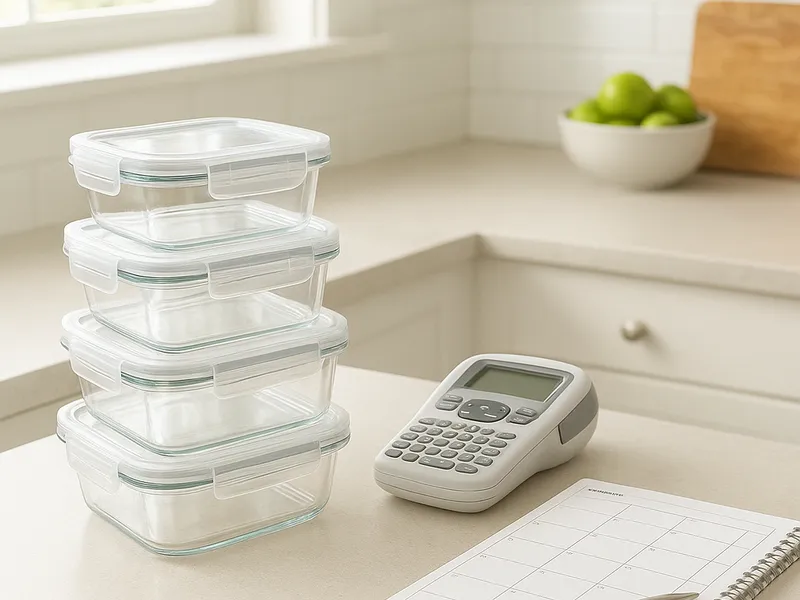
You don't need a drawer full of gadgets to meal prep. The minimal kit that actually works is four items: Rubbermaid Brilliance glass containers (or Pyrex Simply Store on a budget), an Escali Primo digital kitchen scale, two Nordic Ware Naturals half sheet pans, and a roll of dissolvable food labels. That's the whole setup — roughly $70–110 total — and everything else can wait until you know you'll stick with the habit.
The kit at a glance
- Containers: Rubbermaid Brilliance glass (airtight, oven-safe to 450°F) or Pyrex Simply Store (cheaper, widely available) — typically $20–50 per set
- Scale: Escali Primo digital scale — typically $20–30
- Sheet pans: Nordic Ware Naturals half sheet, 2-pack — typically $25–35
- Labels: Dissolvable food labels, 200–500 per roll — typically $8–15
Comparison
| Component | Pick | Typical price | Why it made the kit | Skip if |
|---|---|---|---|---|
| Containers | Rubbermaid Brilliance glass | $30–50 (set) | Airtight locking lids, oven-safe glass to 450°F | You want the lightest option |
| Containers (budget) | Pyrex Simply Store | $15–30 (set) | Trusted glass, snap-on lids, low cost | You need leakproof transport |
| Scale | Escali Primo | $20–30 | 1-gram accuracy, two-button simplicity | You never portion by weight |
| Sheet pans | Nordic Ware Naturals half sheet (2-pack) | $25–35 | Warp-resistant aluminum, even heat | Your oven is compact/countertop |
| Labels | Dissolvable label roll | $8–15 | Wash off with no residue | Masking tape already works for you |
Containers: the backbone of the kit
Containers are where most people overspend, so start with one matched set rather than a mixed bag of orphaned lids. Rubbermaid Brilliance glass is the strongest all-around choice on paper: bases oven-safe to 450°F per the manufacturer, latching lids designed to be airtight, and owners consistently report the seals stay leak-free through repeated dishwasher cycles. The Tritan plastic Brilliance line is a lighter alternative with the same lid design.
Pyrex Simply Store is the budget route — sturdy tempered glass with flexible snap-on lids, often under $30 for a starter set. Owners consistently report the glass outlasts the lids; replacements are sold separately, which keeps the set alive.
If you're weighing glass against plastic or need sizes that fit your fridge, our food storage finder narrows it down by material, capacity, and budget.
Who should skip it: nobody skips containers entirely, but skip the 20-piece bundles — five or six containers in one or two sizes cover a full week of lunches. If you already own a working set with intact lids, spend nothing here.
Kitchen scale: the Escali Primo
Portioning by eye is the quiet reason meal prep drifts — five "equal" servings that aren't. The Escali Primo is the reference budget scale for a reason: in published third-party accuracy testing it registered calibration weights correctly down to 1 gram regardless of where items sat on the platform, and it runs on two buttons with a wipe-clean surface. Manufacturer specs list an 11 lb capacity — enough for a mixing bowl of batch-cooked grains. Owners consistently report years of service, and it typically sells for $20–30.
The OXO Good Grips 11 lb scale (typically $45–55) adds a pull-out display so a large bowl doesn't block the readout — worth it for frequent bakers, overkill for basic portioning.
Who should skip it: if you portion everything with a measuring cup and consistency doesn't bother you, or you already own any working digital scale, skip this line item. It's the most optional piece of the four.
Sheet pans: two Nordic Ware half sheets
Batch roasting is the highest-leverage meal prep technique — two pans of vegetables and a protein while you do something else. The Nordic Ware Naturals half sheet is uncoated aluminum with an encapsulated galvanized steel rim, a spec that exists specifically to resist warping. Owners consistently report pans staying flat after a decade of regular use, and a 2-pack typically runs $25–35 — about what cheap pans that buckle in a year cost. One manufacturer care note: hand wash, since dishwasher detergent gradually darkens bare aluminum (cosmetic, not functional).
