
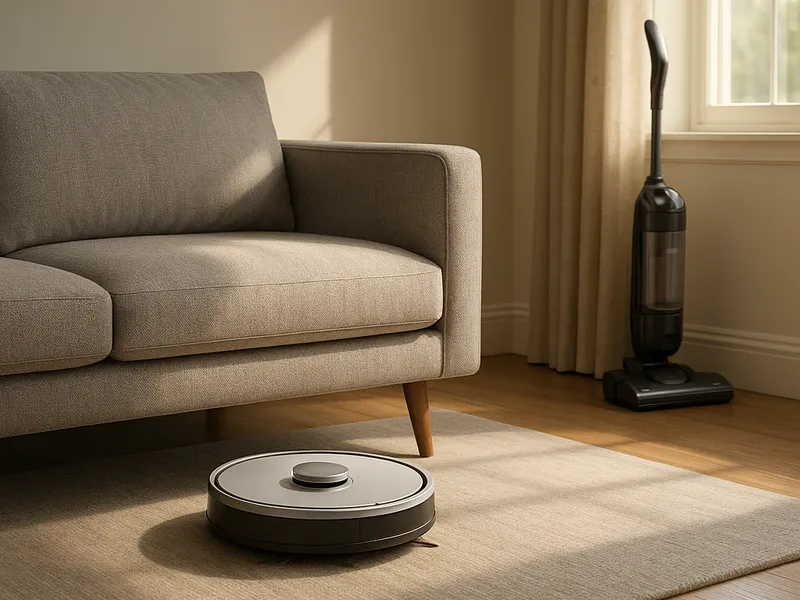
If you only want to buy one, a quality cordless stick vacuum like the Dyson V15 Detect still cleans deeper than any robot, especially on carpet and in corners. But the honest answer is that most homes are best served by owning both: a robot such as the Roborock Q7 M5+ to handle daily maintenance hands-free, and a stick or upright for the deep weekly clean. We would buy a robot first only if your floors are mostly hard surfaces and you value time over a perfect edge-to-edge result.
Our picks at a glance
- Dyson V15 Detect — strongest real-world cleaning across every surface — best for anyone who wants one vacuum that does everything well.
- Roborock Q7 M5+ — automatic daily cleaning with a self-emptying dock at a low price — best for hands-free maintenance on a budget.
- Roborock Saros 10R — flagship navigation, obstacle avoidance and mopping — best for cluttered homes and people who want a true set-and-forget robot.
- Shark cordless (Stratos / PowerDetect line) — long runtime and strong value — best for larger homes that need extended battery without a Dyson price.
- Dyson Ball Animal upright — corded deep-carpet power — best for heavy pet hair and thick carpet.
How to choose
The robot-versus-regular debate really comes down to four questions.
- Floor type. Robots clean hard floors and low-pile carpet well, but they cannot dig into thick or high-pile carpet the way an upright or a powered stick can. If your home is mostly carpet, a regular vacuum should be your primary tool.
- Effort versus result. A robot trades a little cleaning depth for a lot of convenience: it runs while you are out and keeps a baseline of cleanliness every day. A stick or upright gets a deeper single clean but only when you push it around yourself.
- Edges, stairs and clutter. No robot reaches stairs, deep corners, upholstery or under tight furniture as well as a handheld or stick. If those are your problem areas, prioritize a regular vacuum.
- Maintenance and budget. Robots with self-emptying docks cut hands-on emptying to roughly once a month, but docks, mop pads and brushes add ongoing cost. Stick vacuums need bin emptying and filter rinsing but are simpler overall. Use price tiers as your guide: budget robots and sticks start in the $ range, capable mid-range models sit at $$, and flagship robots and premium Dyson sticks reach $$$.
Dyson V15 Detect
Dyson's V15 Detect is a cordless stick vacuum widely treated as the benchmark for all-surface cleaning. It pairs high suction with a laser-illuminated dust head and a self-detangling brushbar that handles hair without wrapping.
- Pros: Excellent pickup on carpet and hard floors, converts to a handheld for stairs and upholstery, strong filtration, swappable battery on some configurations.
- Cons: Premium ($$$) price, you have to do the work yourself, runtime is finite per charge.
Best for: anyone who wants a single vacuum that genuinely deep-cleans everything. Skip it if: you specifically want hands-free daily cleaning, or you only have small hard-floor spaces where a cheaper model suffices.
Roborock Q7 M5+
The Q7 M5+ is a budget-friendly robot vacuum that punches above its tier with LiDAR navigation, strong suction and an included auto-empty dock, so you only handle the bin roughly monthly. It is the easiest, lowest-cost way to keep floors maintained without lifting a finger.
- Pros: Self-emptying dock at a budget price, good mapping and navigation, solid suction for daily debris and pet hair on hard floors.
- Cons: Mopping is basic, will not deep-clean thick carpet, struggles with very cluttered floors compared with flagships.
Best for: apartments and homes with mostly hard floors that want set-it-and-forget maintenance cheaply. Skip it if: you have lots of high-pile carpet or expect mopping to replace a real mop.
Roborock Saros 10R
The Saros 10R is a premium hybrid vacuum-and-mop that reviewers single out for precise navigation, multiple sensors and strong obstacle avoidance, plus capable carpet pickup and pet-hair handling.
- Pros: Best-in-class navigation and obstacle recognition, effective mopping, handles cluttered rooms, full-featured dock.
- Cons: Flagship ($$$) pricing, still not a substitute for a deep upright clean on thick carpet, more maintenance points.
Best for: busy, cluttered or multi-room homes that want a true automated cleaner. Skip it if: your budget is tight or your floors are simple enough that a budget robot would do the same job.
