
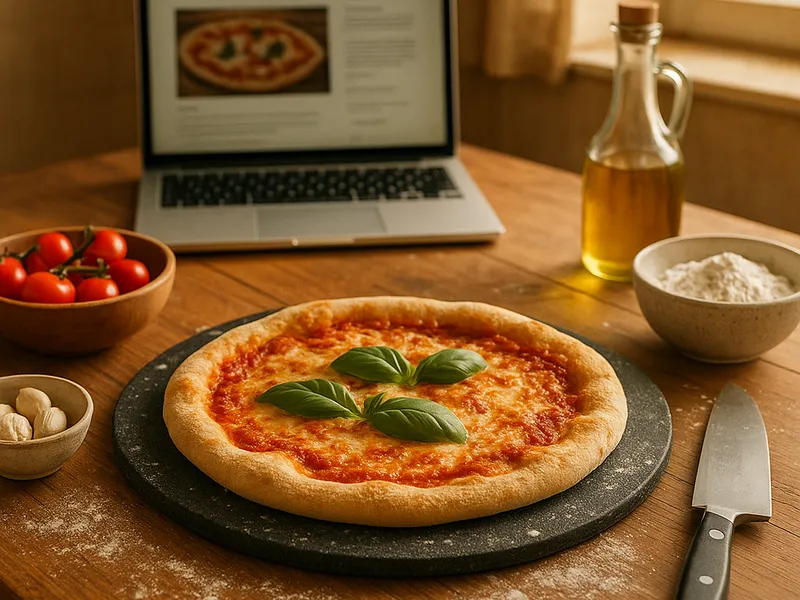
If you want reliable homemade pizza, start with a no-knead cast-iron pan pizza — it forgives beginner mistakes and needs no special equipment — then work up to a cold-fermented New York style on a baking steel, which is the best all-around pizza most home ovens can produce. Neapolitan is the style to chase if you own (or plan to buy) a high-heat pizza oven, while Detroit-style and grandma pies are the easiest ways to feed a crowd from a rectangular pan. These five styles cover the full range of home setups, and each teaches a skill — fermentation, heat management, pan technique — that carries over to every pizza you make afterward.
At a glance
- Best for beginners: No-knead cast-iron pan pizza — 70%+ hydration, no kneading or stretching, 550°F (290°C)
- Best all-around: New York style — 60–65% hydration, 24–72 hour cold ferment, 500–550°F on a steel or stone
- Best with a pizza oven: Neapolitan — 55–62% hydration, 800–900°F (430–480°C), 60–90 second bake
- Best for a crowd: Detroit-style — 70–75% hydration, 475°F (245°C) in an oiled steel pan
- Easiest sheet-pan option: Grandma pie — roughly 64–70% hydration, 450–500°F, thin and olive-oil crisp
No-knead cast-iron pan pizza
This is the widely recommended entry point, popularized by J. Kenji López-Alt's "Foolproof Pan Pizza" at Serious Eats, because it removes the two things that trip up new pizza makers: kneading and stretching. You stir together a wet dough (well above 70% hydration), cover it, and let a 12 to 16 hour room-temperature rest develop gluten and flavor with zero effort. A few hours before dinner, the dough goes into a generously oiled 10-inch cast-iron skillet, where you press it flat and let it proof.
The pan's sides contain the dough, so no shaping skill is required, and the oil essentially fries the bottom crust into a crackly, golden crunch. Bake at 550°F (290°C) if your oven allows it — expect roughly 12 to 15 minutes; at 450°F, plan closer to 20. Top it edge-to-edge with cheese so it caramelizes against the pan walls.
New York style
New York style is the consensus pick for the best pizza a standard home oven can make: a thin, foldable slice with a crisp bottom and chewy rim. The formula that appears again and again in tested recipes is 60–65% hydration (65% is a common sweet spot), a little sugar and oil for browning and tenderness, and — critically — a cold ferment of 24 to 72 hours in the refrigerator, which builds flavor and blistering that same-day doughs can't match.
Bake on a steel or stone preheated for a full hour at 500–550°F in the upper third of the oven so top and bottom finish together; a 12–14 inch pie takes about 6 to 8 minutes. Use low-moisture whole-milk mozzarella (not fresh) and a simple crushed-tomato sauce — restraint is the style's signature.
Neapolitan
Neapolitan is the benchmark style, and it is unusually well documented: the AVPN (the Neapolitan pizza association) specifies roughly 55–62% hydration, finely milled 00 flour, only flour-water-salt-yeast (no oil or sugar), and a bake of 60 to 90 seconds at around 800–900°F (430–480°C). That last number is the catch — a conventional home oven tops out hundreds of degrees short, which is why this style is the main argument for a compact outdoor pizza oven.
The payoff is a soft, puffy, leopard-spotted cornicione and a tender center best eaten with a knife and fork. Keep hydration around 60–62% at home, ferment 8 to 24 hours at cool room temperature or longer in the fridge, and top sparingly: crushed San Marzano-type tomatoes, drained fresh mozzarella, basil, and olive oil. Without a pizza oven, a steel under a preheated broiler is a reasonable approximation, shortening bakes to 3–4 minutes.
Detroit-style
Detroit-style is a high-hydration pan pizza — most tested recipes land around 70–75% water — proofed and baked in a deep rectangular steel pan. The defining features are an airy, open crumb; cheese spread all the way to the pan edges so it fries into a dark, lacy frame (the frico); and sauce ladled on top after or late in the bake, in stripes.
The traditional cheese is Wisconsin brick, a buttery, high-fat cheese that melts evenly; the standard home substitute is low-moisture mozzarella blended with Monterey Jack or a mild white cheddar. Bake at 475°F (245°C) for roughly 12 to 15 minutes total — many recipes par-bake the crust about 5 minutes, then top and finish for another 7 to 10 until the edges are deeply browned. A true Detroit pan helps, but a well-oiled 9×13 metal baking pan works.
