
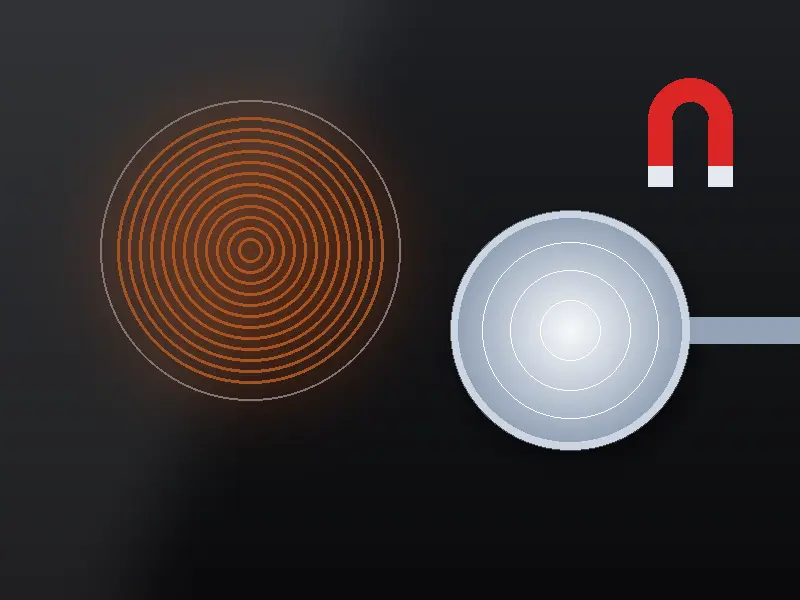
The fastest way to tell if a pan works on induction is the magnet test: if a fridge magnet sticks firmly to the bottom, the pan will heat. Induction cooktops only heat magnetic (ferromagnetic) cookware, so cast iron, enameled cast iron, carbon steel and most clad stainless work, while plain aluminum, copper, glass, clay and many ceramic or aluminum nonstick pans don't unless they have a magnetic steel plate bonded to the base.
If you're buying new, look for "induction-compatible" on the maker's spec sheet or the coil symbol on the base or packaging, then confirm the bottom is flat. Our cookware finder filtered to induction-ready sets shows every compatible set in our database.
Recommended product · Paid link

CAROTE 21Pcs Pots and Pans Set, Nonstick Cookware Sets,
CAROTE 21-piece nonstick set in white granite, induction compatible; includes pots, pans, and lids for versatile cooking
Will my pan work? At a glance
- Works: cast iron (bare or enameled), carbon steel, magnetic stainless, and clad stainless with a magnetic outer layer.
- Works if it has a steel base plate: hard-anodized aluminum nonstick, ceramic nonstick, and some aluminum sets. Check for a visible steel disc on the bottom.
- Doesn't work: plain aluminum, copper, brass, glass, clay, and porcelain or ceramic stoneware.
- Unreliable: warped pans, round-bottom woks, pans that are only partly magnetic on the bottom, and pans much smaller than the cooking zone.
Comparison by material
| Material | Works on induction? | Why | What to check |
|---|---|---|---|
| Cast iron (bare or enameled) | Yes | Iron is strongly magnetic | Lift, don't slide, on the glass |
| Carbon steel | Yes | Magnetic steel | Flat base (some woks are round) |
| Clad stainless (tri-ply, 5-ply) | Usually | Magnetic stainless exterior | Maker's induction rating |
| Single-ply stainless | Sometimes | Some stainless grades aren't magnetic | Magnet test |
| Aluminum nonstick | Only with steel plate | Aluminum isn't magnetic | Steel disc on the base |
| Ceramic nonstick | Only with steel plate | Usually an aluminum body | Steel disc / induction symbol |
| Copper | Rarely | Copper isn't magnetic | Bonded steel base |
| Glass, clay, porcelain | No | Not magnetic | Use a different pan |
How induction actually heats a pan
An induction element is a coil of wire under the glass. Running current through it creates a rapidly alternating magnetic field, which induces an electric current in the base of magnetic cookware, and the pan itself becomes the heat source. The glass gets warm from contact with the hot pan, not from the element. That's why non-magnetic materials don't respond, and why induction responds so quickly when you change the setting. ENERGY STAR puts induction's energy transfer at roughly 85% efficiency, versus about 75–80% for electric resistance elements and about 32% for gas.
The magnet test, step by step
1. Take any fridge magnet and hold it flat against the center of the pan's base.
2. Strong grip: the pan will work. Slides off or no grip: it won't work.
3. Check the whole base, not just the center. GE's induction manuals list a pan that is only partly magnetic on the bottom as unsuitable, and KitchenAid notes partly magnetic bases may heat unevenly. Some aluminum pans have a steel plate that covers only part of the bottom.
Why some stainless steel fails
"Stainless" covers several alloys. Nickel-bearing grades such as 18/10 (type 304, 300-series) are austenitic and generally non-magnetic, while nickel-free 18/0 (400-series) is ferritic and magnetic. Clad cookware made for induction typically uses a magnetic stainless exterior over an aluminum core (All-Clad credits its D3, D5 and G5 lines' induction compatibility to exactly that), so the outside responds to the field while the aluminum spreads heat. That's why two shiny steel pans can behave completely differently on the same cooktop.
Induction-ready sets in our database
All of these are listed as induction-compatible by their makers, per our product database:
| Set | Material | Price tier |
|---|---|---|
| Carote 11-Piece White Granite Nonstick | Nonstick, stainless base | $ |
| Lodge Seasoned Cast Iron 5-Piece | Cast iron | $ |
| Calphalon Classic Stainless Steel 10-Piece | Stainless (impact-bonded base) | $ |
| Cuisinart MultiClad Pro Tri-Ply 12-Piece (MCP-12N) | Tri-ply stainless | $ |
| Ninja Foodi NeverStick Premium 13-Piece (C39600) | Hard-anodized nonstick | $$ |
| Tramontina Tri-Ply Clad 10-Piece | Tri-ply stainless | $$ |
| HexClad Hybrid 7-Piece | Hybrid stainless/nonstick | $$ |
| GreenPan Valencia Pro 11-Piece | Ceramic nonstick | $$$ |
| All-Clad D3 Stainless 10-Piece | Tri-ply stainless | $$$ |
| Le Creuset Signature Enameled Cast Iron 5-Piece | Enameled cast iron | $$$ |
Prices shift with sales; treat these as ballpark ranges.
Not induction-ready in our database: T-fal Ultimate Hard Anodized, GreenLife Soft Grip, Anolon Advanced Home, Farberware Dishwasher Safe Nonstick and Tramontina PrimaWare. All are nonstick sets without a magnetic base (T-fal and GreenLife, for example, state their lines suit all stovetops except induction), and they remain fine choices for gas or radiant electric.
Best picks by situation

- Best value clad stainless: Cuisinart MultiClad Pro (MCP-12N). Full tri-ply construction, oven-safe to 500°F, and owners consistently report years of even heating.
- Best nonstick for induction: Ninja Foodi NeverStick (C39600). Hard-anodized nonstick with an induction-ready base, oven-safe to 500°F.
- Best budget: Carote White Granite 11-Piece for nonstick, or Lodge 5-Piece for cast iron. Carote owners note the coating declines after a year or two of regular use.
- Best buy-it-for-life: All-Clad D3. Tri-ply stainless that owners report still using after 10+ years.
- Best PTFE-free: GreenPan Valencia Pro. Ceramic nonstick on an induction-ready base.
Other things that matter on induction
- Flat bases. The pan needs good contact with the glass. GE's manuals note warped or curved bottoms won't heat evenly and call for a flat-bottomed wok without a support ring.
- Pan size. If a pan is too small for the element, the zone may not detect it and won't turn on. There's no universal minimum: one GE model, for example, needs 5 inches on its front elements and 4.5 to 7 inches on the back ones. Check your cooktop manual and match the pan base to the zone.
- Some noise is normal. A low hum is normal, particularly on high settings, and lighter multi-ply pans tend to be louder than heavy enameled cast iron. Clicking from the cooktop's electronics is also normal, especially at lower power levels.
- Watch empty pans. Induction heats fast. Cookware and cooktop makers warn against heating empty pans, and nonstick should stay on low to medium.
- Protect the glass. Lodge and Le Creuset both advise lifting pans rather than sliding them across the surface.
- Skip interface disks. Converter disks that let a non-magnetic pan sit on induction exist, but several cooktop makers, including GE, Miele and Wolf, advise against them. Check your manual first.
Still choosing a material? Our cookware materials comparison covers the trade-offs, the best cookware sets guide ranks full sets, and more guides live on our Kitchen & Home hub.
*Recommendations are based on manufacturer specifications and patterns in aggregated owner reviews — see our methodology.*
FAQ
How do I know if my cookware is induction compatible?
Hold a magnet to the base. If it sticks firmly across the bottom, the pan will work. You can also look for the coil symbol that most makers stamp on the base or packaging of induction-ready cookware, or check the spec sheet for "induction-compatible."
Does All-Clad work on induction?
All-Clad says its D3, D5 and G5 stainless collections are fully induction compatible thanks to their magnetic stainless exterior, and its HA1 hard-anodized nonstick line adds a stainless induction plate (except on its square and rectangular shapes). Always confirm the specific line and piece, since compatibility varies by collection rather than by brand.
Can I use nonstick pans on an induction cooktop?
Yes, if the pan has a magnetic base. Many hard-anodized and ceramic nonstick lines add a bonded steel plate for exactly this reason. A plain aluminum nonstick pan with no steel disc won't heat.
Why is my induction cooktop buzzing?
A low hum is normal, particularly on high settings, and cooktop makers note that lightweight multi-ply stainless pans hum more than heavy pans like enameled cast iron. Crackling can come from pan bases made of layered materials, and clicking from the cooktop's electronics, especially at low settings. None of these indicate a fault.