
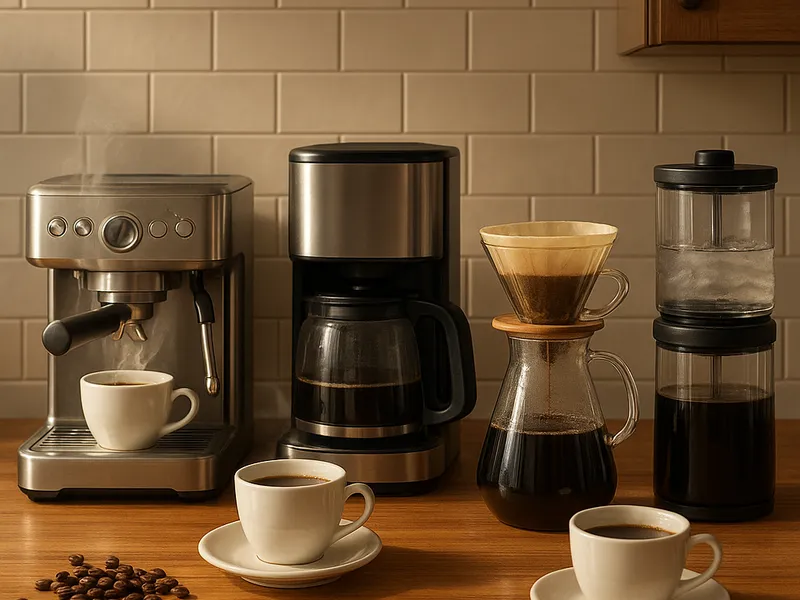
The best coffee maker for most drip drinkers is the Technivorm Moccamaster KBGV Select, a hand-built brewer that hits proper brewing temperature every time. For espresso, the Breville Bambino Plus delivers café-quality shots in a compact footprint, with the De'Longhi Dedica as the budget alternative. Cold brew fans should get the OXO Cold Brew Coffee Maker for tidy countertop batches or the Toddy Cold Brew System for large-volume concentrate. For the least money, the Hario V60 pour-over dripper costs less than a bag of specialty beans.
Our picks at a glance
- Best drip coffee maker: Technivorm Moccamaster KBGV Select
- Best budget drip: OXO Brew 8-Cup Coffee Maker
- Best espresso machine: Breville Bambino Plus
- Best budget espresso: De'Longhi Dedica
- Best cold brew maker: OXO Cold Brew Coffee Maker
- Best cold brew for big batches: Toddy Cold Brew System
- Best pour-over (and cheapest way in): Hario V60
Comparison
| Model | Type | Capacity | Typical price range |
|---|---|---|---|
| Technivorm Moccamaster KBGV Select | Drip | 10 cups (40 oz) | $330–$370 |
| OXO Brew 8-Cup | Drip | 8 cups | $150–$200 |
| Breville Bambino Plus | Semi-automatic espresso | Single/double shots | $400–$500 |
| De'Longhi Dedica | Semi-automatic espresso | Single/double shots | $200–$300 |
| OXO Cold Brew Coffee Maker | Cold brew (immersion) | 32 oz concentrate | $45–$55 |
| Toddy Cold Brew System | Cold brew (immersion) | ~40 oz concentrate | $40–$50 |
| Hario V60 | Pour-over | 1–4 cups | $10–$30 |
Technivorm Moccamaster KBGV Select: best drip coffee maker
The Moccamaster is hand-assembled in the Netherlands, certified by the Specialty Coffee Association, and built around a copper heating element that keeps brew water in the ideal 195–205°F extraction range — a spec many cheaper machines miss. It brews a full 40-ounce carafe in about six minutes, and nearly every part is user-replaceable, which is why owners consistently report machines still running after a decade or more.
Who should skip it: Anyone who wants programmability. There's no timer, no app, no strength presets beyond a half/full-carafe switch. If you want scheduled wake-up coffee or adjustable brew profiles, look at the OXO below or Breville's Precision Brewer.
OXO Brew 8-Cup: best budget drip
The OXO Brew 8-Cup is also SCA-certified, so you get proper brew temperature and even saturation via a rainmaker-style showerhead at roughly half the Moccamaster's price. It has a double-walled thermal carafe (no scorching hot plate), a 24-hour start timer, and controls simple enough to operate half-asleep. Owners consistently report that the small-batch mode — 2 to 4 cups — tastes just as good as a full pot, which is rare in this category.
Who should skip it: Large households. Eight cups in coffee-maker math is closer to four real mugs, so if you're pouring for a crowd, step up to a 10- or 12-cup machine.
Breville Bambino Plus: best espresso machine
The Bambino Plus packs Breville's ThermoJet heating system — ready to pull a shot in about three seconds — plus a 54mm portafilter, low-pressure pre-infusion, and automatic milk steaming with adjustable temperature and texture into a machine under eight inches wide. Owners consistently report that the auto steam wand produces genuinely silky microfoam, making it one of the friendliest paths to homemade lattes. Because it uses a non-pressurized basket, it rewards good technique and — critically — a good grinder; pair it with one of our picks in the best coffee grinders for home, since espresso is unforgiving of uneven grounds.
Who should skip it: Anyone who wants push-button convenience. Dialing in grind size and dose takes practice, and there's no built-in grinder; if you want fully hands-off espresso, a super-automatic costs more but does everything for you.
De'Longhi Dedica: best budget espresso
At just six inches wide, the Dedica fits kitchens where the Bambino won't, and its thermoblock heats up in well under a minute. It ships with pressurized baskets that produce reliable crema even with pre-ground supermarket coffee — exactly what beginners need. Owners consistently report it's an easy, forgiving first machine, though the manual steam wand takes practice for latte-quality foam.
Who should skip it: Aspiring hobbyists. The pressurized baskets that make it forgiving also cap how good the espresso can get, and serious upgraders tend to outgrow it quickly.
OXO Cold Brew Coffee Maker: best cold brew
OXO's brewer is the tidiest way to make cold brew at home: a rainmaker lid distributes water evenly over the grounds, a switch drains the finished concentrate into a glass carafe, and the whole thing stores compactly. It yields up to 32 ounces of concentrate — roughly a week of iced coffee once diluted — and owners consistently report that cleanup is dramatically easier than mason-jar methods.
